Jiggling and Beveling in Dish Ends: Importance in Pressure Vessel and Tank Fabrication
Dish ends are formed metal heads or ends that are used for closing the ends of pressure vessels, storage tanks, reactors, boilers, heat exchangers, and industrial process equipment. Dish ends are designed and fabricated to handle internal pressure, provide improved strength and structural integrity, and support safe industrial operations. Dish end fabrication is an extremely important process in heavy engineering and industrial fabrication.
Some of the most critical processes that go into the fabrication of dish ends include jigging and beveling. Jiggling and beveling are two important fabrication processes that have a significant impact on the fit-up, welding joint strength, dimensional accuracy, pressure handling capability, and fabrication efficiency of pressure vessels, storage tanks, reactors, and industrial equipment. Industries that use pressure vessels and storage tanks for safe operations, such as oil & gas, petrochemical, power generation, pharmaceutical, food processing, water treatment, chemical processing, and other industrial sectors, depend heavily on precision-fabricated dish ends for improved strength and long-term safety.
Companies like ASEFS India, specializing in dish end fabrication, pressure vessel fabrication, industrial tank manufacturing, stainless steel fabrication, custom fabrication solutions, steel fabrication services, piping fabrication services, reactor vessel fabrication, storage tank fabrication, ASME pressure vessel fabrication, heavy fabrication services, corrosion-resistant tank fabrication, industrial engineering solutions, blasting and painting solutions, hot dip galvanizing, skid-mounted tank fabrication, rubber lining services, anti-vortex plate fabrication, metal floor grating solutions, and turnkey industrial fabrication services, offer precision-engineered dish ends for industrial applications.
Also Read: “Powder Coating Services: Benefits, Process & Industry Applications Explained”
What is a Dish End?
A dish end is a formed metal head that is welded or bolted on both ends of pressure vessels, storage tanks, reactors, boilers, heat exchangers, and industrial process equipment. Dish ends are designed to be better at handling internal pressure compared to a flat plate.
Types of Dish Ends:
- Torispherical dish ends
- Elliptical dish ends
- Hemispherical dish ends
- Flanged dish ends
- Conical dish ends
Pressure vessel experts state that the curved geometry of dish ends allows for stress distribution across the internal surface of industrial vessels.
Companies like ASEFS India offer dish-end fabrication, industrial tank manufacturing, reactor vessel fabrication, pressure vessel fabrication, stainless steel tank fabrication, heavy fabrication services, and engineering fabrication solutions for industrial sectors.
Process of Jiggling in the Dish Ends
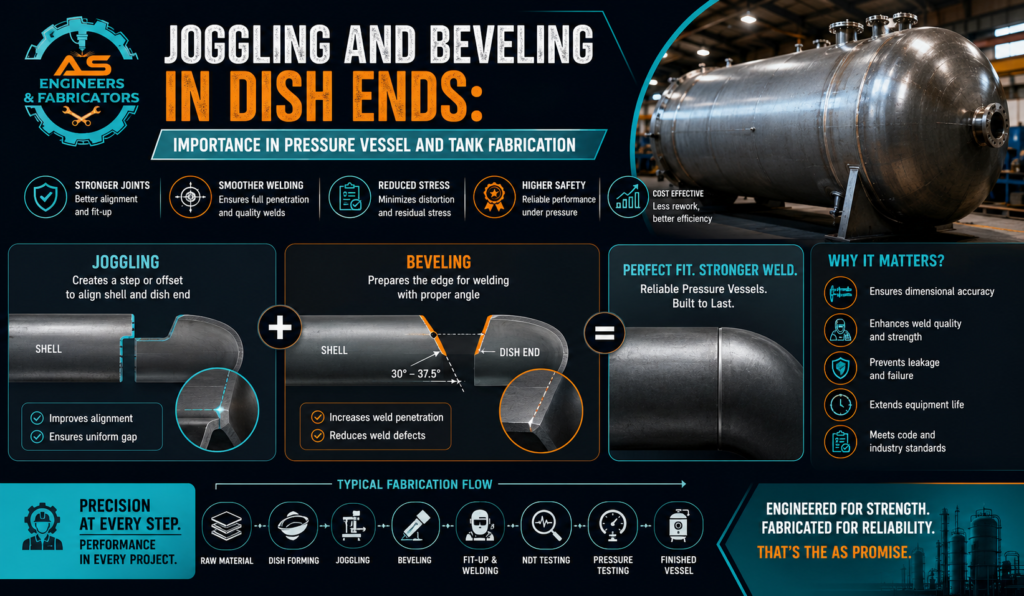
Jiggling is a fabrication process that creates a step or an offset section along the periphery of a dish end. The flanged section helps in the proper alignment and fitment of the dish ends to the shell section in a vessel.
The joggled edge improves the following:
- Alignment of welding seams
- Strength of welding joints
- Dimensional accuracy
- Fabrication efficiency
- Structural stability
Jiggling is commonly performed in pressure vessel fabrication, industrial tank manufacturing, and heavy engineering applications.
Industry experts state that jiggling makes it easy to position the parts during assembly and also improves welding quality.
Companies such as ASEFS India specialize in dish end fabrication, pressure vessel fabrication, industrial fabrication services, custom steel fabrication, piping fabrication services, heavy engineering solutions, and industrial tank manufacturing using modern fabrication processes.
Importance of Jiggling in Pressure Vessel Fabrication
Improved Fit-Up Accuracy Jiggling improves the fit-up between the dish end and cylindrical shell section.
The proper alignment helps to minimize the following:
- Welding gaps
- Dimensional mismatch
- Assembly errors
- Fabrication delays
Accurate fit-up also helps to improve the quality of welding and structural reliability of pressure vessels and storage tanks.
Companies like ASEFS India offer pressure vessel fabrication, industrial tank fabrication, heavy fabrication services, dish end manufacturing, piping fabrication services, and steel fabrication solutions for high-precision industrial applications.
Better Welding Strength
Jiggling improves welding joint positioning and also provides stronger welding support during fabrication.
The jiggling process helps to achieve the following:
- Uniform weld penetration
- Reduced stress concentration
- Joint stability
- Improved structural integrity
Pressure vessel experts state that the quality of welding has a significant impact on the safety and pressure handling capability of industrial vessels.
Companies such as ASEFS India provide ASME pressure vessel fabrication, certified welding services, stainless steel fabrication, heavy fabrication solutions, reactor vessel fabrication, and industrial engineering services for industrial fabrication in harsh environments.
Reduced Fabrication Time
Jogged dish ends allow easy assembly and reduced manual adjustments during fabrication.
The benefits include:
- Faster shell alignment
- Easier welding setup
- Reduced labor efforts
- Improved production efficiency
Industrial fabrication companies often make use of jigging to improve productivity in large-scale manufacturing of pressure vessels.
Companies like ASEFS India specialize in industrial fabrication services, custom fabrication solutions, pressure vessel manufacturing, storage tank fabrication, piping fabrication services, and turnkey fabrication solutions for industrial fabrication projects.
Process of Beveling in Dish Ends
Beveling is the process of creating an angled edge preparation on the dish ends and shell plates before welding.
The bevel edge helps with proper weld penetration and also allows stronger welding joints during pressure vessel fabrication.
Common types of bevels include:
- Single bevel
- Double bevel
- V bevel
- U-bevel
- J bevel
Industry experts state that bevel edge preparation is extremely important in order to achieve high-quality welds in thicker sections of metal.
Companies such as ASEFS India provide beveling services, pressure vessel fabrication, industrial welding solutions, piping fabrication services, stainless steel fabrication, and heavy engineering fabrication for industrial applications.
Importance of Beveling in Pressure Vessel and Tank Fabrication
Stronger Weld Penetration Beveling creates enough space for penetration of the weld material, ensuring strong fusion between the metal sections.
This process improves:
Weld strength
Pressure resistance
Structural durability
Joint reliability
Pressure vessel industries are heavily dependent on bevel preparation for safe welding.
Companies like ASEFS India provide ASME pressure vessel fabrication, industrial welding services, piping fabrication solutions, heavy steel fabrication, custom tank fabrication, and industrial engineering solutions for industrial applications with high-pressure content.
Reduced Welding Defects
Beveling also helps to reduce welding defects.
Such as:
- Cracks
- Incomplete penetration
- Porosity
- Slag inclusion
- Weld failure
Industry references state that beveling or edge preparation is one of the most important things to be done in order to maintain good welding quality.
Companies such as ASEFS India provide industrial fabrication services, welding inspection solutions, pressure vessel fabrication, stainless steel fabrication, heavy engineering services, and quality-controlled fabrication solutions for industrial safety standards.
Improved Pressure Resistance
Pressure vessels and industrial tanks have to handle high internal pressure. Weak weld joints could become a major safety issue in such vessels.
Beveling helps to improve the pressure handling capability of industrial vessels by creating strong and uniform welded joints.
This is extremely important in the following ways:
- Reactors
- Boilers
- Heat exchangers
- Air receiver tanks
- Chemical storage tanks
Companies like ASEFS India specialize in pressure vessel fabrication, reactor vessel manufacturing, industrial tank fabrication, piping fabrication services, corrosion-resistant tank fabrication, and engineering fabrication solutions for industrial applications.
Jiggling and Beveling Process in Dish End Manufacturing
The general process for dish end manufacturing.
The jigging and beveling process generally includes the following:
- Material selection
- Plate cutting
- Dish forming
- Edge trimming
- Jogging process
- Bevel edge preparation
- Welding inspection
- Surface finishing
Modern fabrication facilities make use of CNC machinery and hydraulic forming equipment for precise fabrication.
Companies such as ASEFS India provide sheet metal fabrication, industrial fabrication services, pressure vessel engineering, custom fabrication solutions, heavy fabrication services, and industrial manufacturing solutions using modern production technologies.
Industries Using Joggled and Beveled Dish Ends
Joggled and beveled dish ends are used.
Oil & gas industries:
- Petrochemical plants
- Chemical industries
- Pharmaceutical plants
- Food processing industries
- Water treatment facilities
- Power generation plants
The industries listed above require high-strength pressure vessels and corrosion-resistant industrial tanks for safe operations.
Companies like ASEFS India provide industrial tank manufacturing, pressure vessel fabrication, reactor vessel fabrication, piping fabrication services, stainless steel fabrication, heavy engineering solutions, and corrosion-resistant fabrication services for industries worldwide.
Material Options for Dish Ends
Dish ends are made from a variety of different materials depending on the application needs.
Common materials used in dish end manufacturing include:
- Carbon steel
- Stainless steel
- Duplex stainless steel
- Alloy steel
- Mild steel
The choice of material depends on:
- Pressure rating
- Corrosion exposure
- Temperature conditions
- Chemical compatibility
Companies such as ASEFS India provide stainless steel tank fabrication, industrial fabrication services, corrosion-resistant tank manufacturing, pressure vessel engineering, steel fabrication services, and custom industrial fabrication solutions using certified materials.
Surface Finishing and Corrosion Protection
Industrial die ends require the application of protective surface treatments for improved durability and corrosion protection.
Common surface finishing methods include:
- Sandblasting
- Shot blasting
- Industrial painting
- Epoxy coating
- Hot dip galvanizing
Industry experts state that proper surface preparation helps to improve the adhesion of coatings and extend the life of equipment.
Companies like ASEFS India provide blasting and painting solutions, hot dip galvanizing services, industrial coating solutions, corrosion protection systems, and industrial engineering services for long-term industrial equipment performance.
Also Read: “Hot Dip Galvanizing: Why It Is the Most Reliable Steel Protection Method”
Conclusion
Jigging and beveling are two extremely important fabrication processes in dish-end manufacturing. The two processes help to improve the fit-up, welding quality, pressure resistance, fabrication efficiency, and structural integrity of dish ends, pressure vessels, and industrial tanks. Jiggling and beveling help to ensure safe and reliable performance of pressure vessels, storage tanks, reactors, boilers, heat exchangers, and industrial process equipment.
Industries such as oil & gas, petrochemical, power generation, chemical processing, pharmaceutical manufacturing, and water treatment require precision-fabricated dish ends for safe operations. Companies like ASEFS India, which specializes in dish end fabrication, pressure vessel fabrication, industrial tank manufacturing, stainless steel fabrication, custom fabrication solutions, steel fabrication services, piping fabrication services, reactor vessel fabrication, storage tank fabrication, ASME pressure vessel fabrication, heavy fabrication services, corrosion-resistant tank fabrication, industrial engineering solutions, blasting and painting solutions, hot-dip galvanizing, skid-mounted tank fabrication, rubber lining services, anti-vortex plate fabrication, metal floor grating solutions, and turnkey industrial fabrication services, continue to provide reliable fabrication solutions for industrial applications.
Frequently Asked Questions
- What is jiggling in the dish end fabrication?
Ans: Jiggling is a fabrication process that creates an offset edge on the dish ends in order to allow proper alignment and fit-up during vessel assembly.
- Why is beveling important in pressure vessel fabrication?
Ans: Beveling improves weld penetration, welding joint strength, and pressure resistance of industrial vessels.
- Which industries use joggled and beveled dish ends?
Ans: Oil & gas, petrochemical, pharmaceutical, food processing, power generation, and chemical industries are some of the most common industrial sectors that widely use joggled and beveled dish ends.
- What materials are commonly used for dish ends?
Answer: Carbon steel, stainless steel, duplex steel, alloy steel, and mild steel are commonly used.
- Why are welding quality and edge preparation important in pressure vessels?
Ans: Good welding quality and proper edge preparation help to improve the structural integrity, safety, and long-term pressure-handling capability of pressure vessels and industrial tanks.
Recent Posts
-
 Compressor Valve Plate Manufacturer and Exporter in India: Uses and Benefits
 -
 Delrin Cable Rollers Manufacturer & Exporter from India for Industrial Applications
 -
 How to Import Industrial Products from India – Step-by-Step Guide
 -
 Delrin Parts Manufacturer & Exporter from India for Drones and Robotics
 -
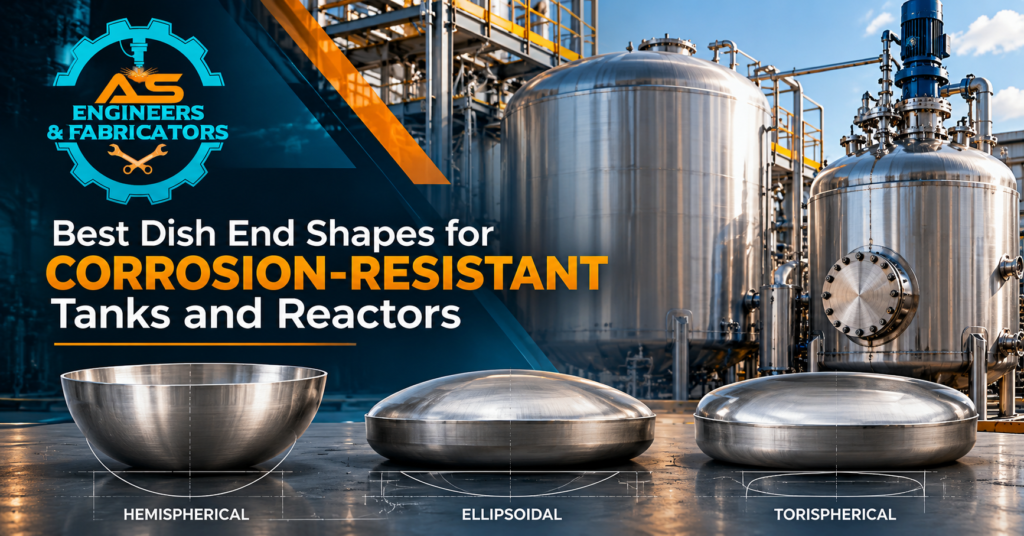 Best Dish End Shapes for Corrosion-Resistant Tanks and Reactors
 -
 Propane Storage Tank Manufacturing: Standards, Safety Features & Buying Guide
 -
 Pressure Vessel Baffle Plates: Function, Placement & Design Guidelines for Better Flow Control
 -
 Why Delrin (Acetal) Machine Parts Outperform Metal Components in Wear Applications
 -
 Delrin Sprocket Gears vs Delrin Spur Gears: Which One Fits Your Machine Design?
 -
 Forming Clad Dish Ends and Ellipsoidal Heads: Process, Materials & Applications
 -
 ASEFS India and Russia’s Industrial Machinery Sector: Solutions, Expertise and Opportunities
 -
 How ASEFS India Contributes to Singapore’s Industrial Machinery and Equipment Sector
 -
 Construction Indonesia 2026: Connecting Global Construction and Engineering Companies with Indonesia’s Infrastructure Market
 -
 AUTOMEX Penang 2026: Connecting Global Automation Companies with Malaysia’s Smart Manufacturing Industry
 -
 Vietnam Industrial Automation Fiesta (VIAF) 2026: Connecting Global Engineering Companies with Vietnam’s Smart Manufacturing Industry

At A.S. Engineers & Fabricators, our team excels in designing, manufacturing, and erecting steel structures that set industry benchmarks. We have established a robust presence in metal fabrication, heavy equipment, and steel structures, providing top-tier solutions for industrial plants and high-rise buildings.