By A.S. Engineers & Fabricators Technical Team, 38+ Years, Ambernath MIDC, Maharashtra. Industrial equipment is under constant mechanical stresses. Gears, rollers, bushings, guide components, wear strips, sprockets, and other moving parts are subjected to friction, repeated motion, and contact loads during their service life. Traditionally, many of these components have been made from metals such as steel, aluminium, and bronze.
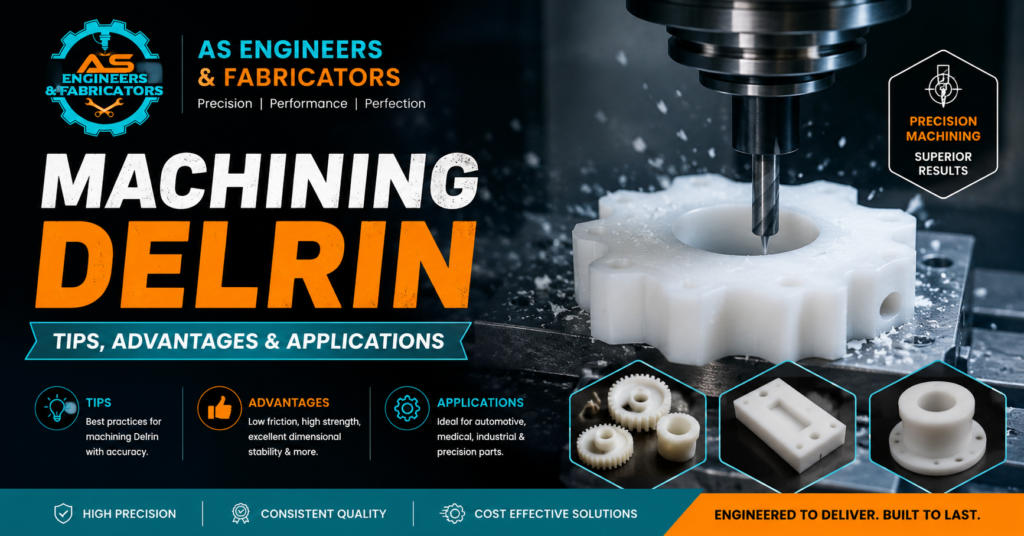
However, engineering plastics have become an important alternative for particular wear applications. Among them is Delrin, generally known as acetal homopolymer, widely used in precision machine components where low friction, dimensional stability, lightweight construction, and wear resistance are needed.
Delrin machine parts can offer practical advantages for industrial equipment, where traditional metal parts may be unnecessarily heavy, require more maintenance, or create excessive friction and noise.
The important point is not that Delrin takes the place of metal in every application. But it has engineering properties that make it a good candidate for certain mechanical conditions where the required load, speed, temperature, and wear requirements can be satisfied with plastic components.
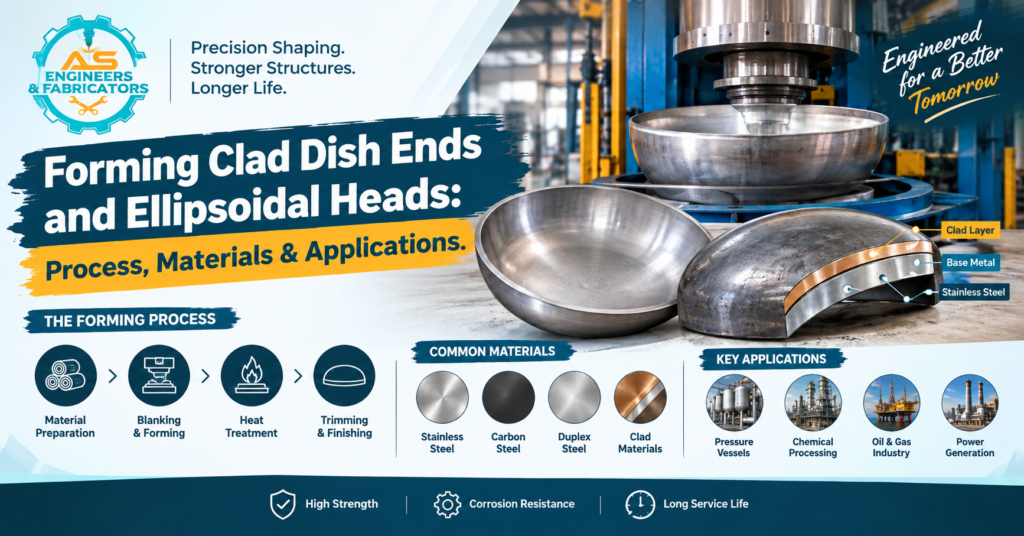
Also Read: Forming Clad Dish Ends and Ellipsoidal Heads: Process, Materials & Applications
Delrin is a trade name widely used for POM-H, an acetal homopolymer. Acetal is an engineering thermoplastic that combines high mechanical strength, stiffness, and good dimensional stability with low friction and excellent wear resistance.
These attributes make it well suited for precision-machined industrial components.
Gears (aka
Sprockets
Bushings (
Rollers
Guide parts
Wear strips
Ball bearings
The stacks
3 Spacers.
Sealing parts
Specially machined parts
Delrin is a good material, but the actual suitability depends on the application, material grade, geometry, operating temperature, load, and environmental conditions.
The selection of Delrin versus metal should be dictated by engineering requirements, not material preference alone.
In many demanding applications, metal components provide high strength, temperature capability, and load-carrying ability. However, they may also add more weight to the components, corrosion problems, more friction in some material combinations, and more noise during mechanical contact.
In the right applications, Delrin can solve some of these problems.
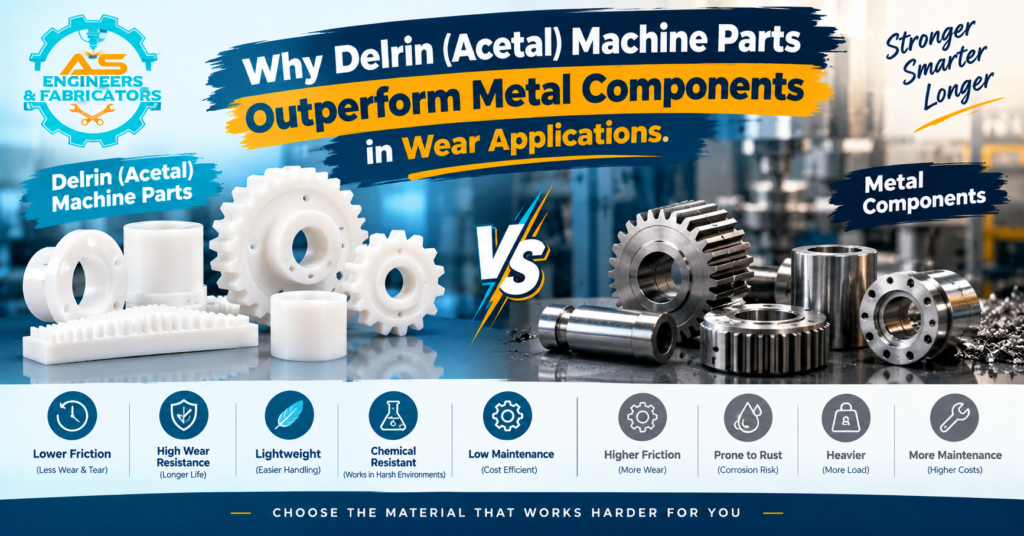
Low friction
Good abrasion resistance
Lightweight design
Good dimensional stability
Corrosion-Resistant
Low moisture absorption as opposed to many other plastics
Well finished
Lower mechanical noise in appropriate applications
Electrical insulation;
Reduced lubrication requirements in some applications
These features explain why Delrin machine parts for industrial equipment are increasingly being considered for certain moving and wear components.
Friction is one of the big problems with moving machine parts.
Friction is the resistance that occurs when two surfaces move against each other and can lead to the production of heat and the loss of material. Therefore, the selection of a material with suitable friction properties can lead to an increase in the efficiency and the service life of a component.
Delrin has relatively low friction characteristics when compared with many conventional engineering materials.
Bushings
Bearings
Rollers
Sliding guides
Wear stripes
Gears
Sprocket
A properly designed Delrin component can provide a lower-friction material interface in applications where metal-on-metal contact is undesirable.
Machinery in industry is often subject to thousands or millions of repeated cycles of movement.
Components such as guide blocks, rollers, bushings, and gears may be in continuous surface contact. Therefore, wear resistance is important for the selection of materials.
Delrin is useful for many applications involving repetitive motion because of its hardness, stiffness, and friction characteristics. But wear performance is not dictated by material alone.
Contact pressure
Speed of sliding
Finish of surface
Counterface materials
Temperature; heat
Petroleum
Charge cycles
Form of component
If these factors are kept in the acceptable operating range of the material, a properly designed Delrin part can deliver reliable wear performance.
Density is one of the more apparent differences between Delrin and metal.
Delrin parts are significantly lighter than steel parts of a similar volume. When moving mass has an impact on energy consumption, acceleration, positioning, or the overall weight of the equipment, reducing component weight can be useful.
high-speed systems
Machines (automated)
Robots
Conveyor parts
Packaging machinery
Little drive mechanisms
Material handling systems
The reduction of moving mass can also simplify mechanical design in appropriate applications.
Metal parts can corrode, depending on the material and the environment in which they are used.
Moisture, chemicals, humidity, and exposure to aggressive substances can cause corrosion-related maintenance problems.
Delrin doesn’t rust or corrode like conventional steel components. This means that acetal components are ideal for applications where corrosion resistance is important.
Damp operating environments
Material-handling equipment
Packaging equipment
Chemical processing support gear
Food processing machinery where the chosen grade is appropriate
Applications involving washdown where material compatibility is proven
Chemical compatibility must be assessed based on actual chemicals, concentration, temperature, and exposure time.
Metal gears, rollers and sliding parts can create considerable mechanical noise, especially at higher speeds.
Sometimes the impact noise and vibration are reduced by the substitution of an engineering plastic part with a suitable metal part in mechanical arrangements.
Plastic Gear
Rollers
Elements of the Guide
Bushes
Conveyor parts
Small mechanical drives
The actual noise level is a function of the total machine design, i.e., speed, alignment, tooth geometry, surface finish, load, and surrounding structure.
When building machine components, precision is important.
If a gear’s dimensions differ from what they should be, its teeth may mesh poorly. The dimensional change of a bushing can affect the shaft clearance. Movement of the machine can also result from inaccurate guide components.
Delrin is known for its good dimensional stability compared to many general-purpose plastics.
Gears
Bushing
Rulers
Spacers (https://www.
Block guides
Mechanical fastening
Custom machinery parts
However, moisture and temperature conditions must be taken into account in the engineering design.
Lubrication is an important aspect of industrial machinery maintenance. However, not all components require the same lubrication arrangement.
The friction and wear characteristics of the material allow some Delrin components to work with little or no additional lubrication in some applications.
This can be useful for components that are difficult to access after installation.
Bushings
Excerpt from Guide
Skates
Gears.
Sliding parts
That doesn’t mean that every Delrin part is maintenance-free out of the box. Lubrication is determined by load, speed, temperature, mating material, and environmental conditions.
Property | Delrin / Acetal | Metal Components |
Weight | Low | Generally higher |
Corrosion resistance | Good | Depends on metal and surface treatment |
Friction | Generally low | Varies significantly |
Wear performance | Good in suitable applications | Often excellent, depending on material |
Noise | Can reduce mechanical noise | Can be higher in some contact applications |
Electrical insulation | Good | Generally conductive |
Machinability | Good | Depends on metal |
High-temperature capability | More limited | Often higher |
Heavy-load capability | Application dependent | Often higher |
Lubrication | May be reduced in selected applications | Often application dependent |
This comparison shows why the material must be chosen according to the actual operating conditions of the machine.
Acetal is a versatile material and can be used to make a variety of machine components.
Delrin gears are used when a lighter weight, lower friction, and quieter gearbox are needed.
Machine equipment
Gearboxes small
Actuators (actuators)
Tools
Packaging equipment
Sprockets are designed to engage chains and can be manufactured from Delrin for some light and moderate duty applications.
Conveyor
Packaging systems
Handling equipment
Chain-based machinery
Bushings are a bearing surface between moving parts. Delrin bushings are recommended for applications where low friction and corrosion resistance are important.
Material handling and conveying applications use lightweight rollers.
Wear strips are a replaceable sliding surface between machine parts to reduce metal-to-metal contact.
Often, industrial equipment requires parts fabricated to a particular machine drawing.
Spacers
guide block
Moving Parts
Parts to bear
Insulating parts
Special gears
Special Sprockets
Particular wear parts for each machine
Delrin machine parts for industrial equipment can be helpful for a range of industries as well as mechanical systems.
Packaging equipment often has high-speed moving parts where low friction, low weight, and noise reduction are important.
Delrin rollers, wear strips, guides, and sprockets are also available for suitable conveyor applications.
Lightweight precision parts that can move repeatedly, over and over again, are often required by automated machines.
Guide components, rollers, and wear strips can help control material movement while minimising direct metal-to-metal contact.
Some grades of acetal are used in food-processing applications where the material properties and regulatory requirements are appropriate. Exact grade and application to be confirmed before use.
There are many rotating and sliding parts in textile machines that could benefit from low friction and light weight.
Robotic mechanisms could benefit from lighter components, especially in moving assemblies.
Delrin machined precision parts are useful for instruments and mechanical control systems where dimensional stability and low friction are important.
Delrin is not a metal substitute for every application.
Loading capacity very high.
Impact resistance (high)
High operating temperatures
High structural rigidity
Long-term high-temperature operation
Heavy abrasive conditions
Heavy-duty pressure vessels, water treatment
For example, a heavily loaded structural shaft or pressure bearing component may need a metal alloy rather than an engineering plastic.
The proper way is to take the entire operating envelope into account before selecting the material.
Engineers should evaluate the following before replacing a metal component with Delrin:
Determine peak and continuous loading.
Increased sliding or rotational speeds can lead to increased heat generation and wear.
Acetal is more temperature-limited than many of the metals used in industry. You want to think about temperature peaks and averages.
Friction and wear can be significantly affected by the material contacting the Delrin component.
Verify compatibility with oils, solvents, cleaning chemicals, and process fluids.
Thermal expansion. When designing, you have to take into account the tolerances in manufacturing.
Delrin has relatively low moisture absorption as compared to many plastics; however, environmental conditions should be considered.
Check the operating cycles required and the wear performance expected of the selected component.
Delrin components used in industrial equipment are produced using precision manufacturing processes.
Machined CNC
Turning
Milling
Drilled
Ream
Custom profile machining
Inspection dimensionale
Material grade
Component size
Allowances
Bore diameters
Surface needs
Sprocket or gear specifications
Installation details
Number of
Requirements of the application
Close coordination between the machine designer and component manufacturer can help ensure that the finished part meets the intended operating conditions for complex industrial components.
Dimensional variation can affect the assembly and performance of precision machine parts, so quality control is essential.
Verification of material
General dimensions
Diameter of bore
Concentricity
Tooth Size
Surface finish
Flatness
Profile precision
Visual examination
Check fitment.
Inspection requirements for production parts should be based on critical dimensions and engineering requirements for the application.
Industrial machinery often has parts that are not available in standard sizes. Custom Delrin manufacturing enables parts to be produced for specific equipment requirements.
Profile of the special gear
Custom sizes of sprockets.
Bore sizes not standard
Keyways.
Custom hubs
Special bushings:
Wear bands
Roller bottle
Guide blocks
Components specific to the machine
A detailed technical drawing, material requirements, operating speed, load, and application information can help in establishing the correct manufacturing approach.
A.S. Engineers & Fabricators (ASEFS India)
Plot No. W-108/1, Anand Nagar, MIDC Ambernath East, Thane – 421506, Maharashtra, India.
WhatsApp: +91 92267 69978
Email: info@asefsindia.com
Catalogue: ASEFS India Product Catalogue
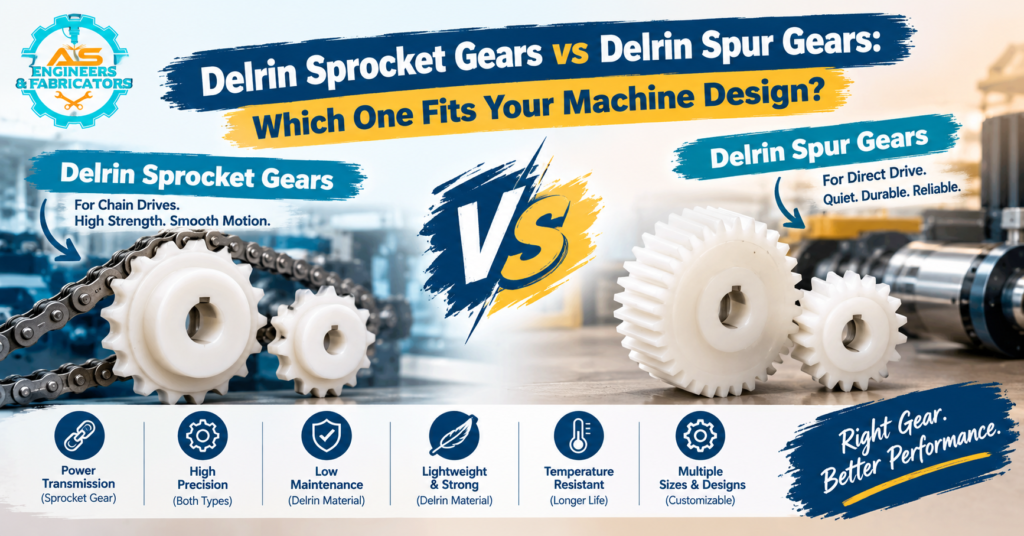
Also Read: Delrin Sprocket Gears vs Delrin Spur Gears: Which One Fits Your Machine Design
Many industrial machine components benefit from Delrin’s low friction, wear resistance, light weight, dimensional stability, and corrosion resistance. It is a useful engineering material for some applications where conventional metal parts would add unwanted weight, noise, or maintenance requirements.
But don’t think of Delrin as a universal replacement for metal. However, metal components may still be needed when high loads, extreme temperatures, severe impact, and demanding structural applications are encountered.
The most important step for engineers considering using Delrin machine parts for industrial equipment is to evaluate the entire operating environment, including rubber-lined tanks, including load, speed, dish ends, temperature, wear, mating materials, and expected service life. When properly designed and material selected, Delrin can provide dependable performance in gears, sprockets, bushings, rollers, wear strips, and other precision machine components.
A. S. Engineers & Fabricators ASEFS India from Ambernath MIDC, Maharashtra, offers engineering and fabrication solutions for industrial applications. Before you start producing, check that your machine specification is compatible with the requirements of your custom component.
1. What are machined Delrin parts?
Ans: Delrin machine parts are mechanical components made from Delrin or an appropriate acetal material. Examples include gears, sprockets, bushings, rollers, wear strips, and custom precision parts.
2. Why Delrin instead of metal?
Ans: Delrin provides low friction, lightweight, corrosion resistance, good dimensional stability, and reduced noise in suitable applications. This decision is based on the operation requirements of the machine.
3. Delrin Mechanical Components for Industrial Machinery
Ans: Yes, Delrin components can be used in many industrial machines where their load, speed, temperature, and wear properties are appropriate.
4. Are Delrin gears strong?
Ans: Delrin gears can have good wear performance if the load and speed are right. Service life depends on gear geometry, mating material, temperature, lubrication, and operating cycles.
5. Can steel parts be replaced with Delrin?
Ans: Delrin can replace steel or other metals in some applications, especially for lightweight, low-friction, and corrosion-resistant parts. Not suitable for all high-load or high-temperature applications.



At A.S. Engineers & Fabricators, our team excels in designing, manufacturing, and erecting steel structures that set industry benchmarks. We have established a robust presence in metal fabrication, heavy equipment, and steel structures, providing top-tier solutions for industrial plants and high-rise buildings.
+91 92267 69978
+91 89569 38780
info@asefsindia.com
2025 © A.S Engineers - All rights reserved