Forming Clad Dish Ends and Ellipsoidal Heads: Process, Materials & Applications
By A.S. Engineers & Fabricators Technical Team, 38+ Years, Ambernath MIDC, Maharashtra. Pressure vessels, reactors, heat exchangers, storage tanks, and process equipment are subject to demanding pressure, temperature, and chemical conditions. Thus, the quality of the vessel head is an important factor in the overall reliability and service life of the equipment.
Clad dish ends and ellipsoidal heads are widely used in industrial pressure equipment where structural strength, corrosion resistance, dimensional accuracy, and reliability of fabrication are necessary.
A.S. Ambernath MIDC, Maharashtra-based Engineers & Fabricators (ASEFS India) are the manufacturers of customised dish ends and pressure vessel components for industrial applications. ASEFS India has over 38 years of experience in engineering and fabrication and can offer solutions according to customer drawings, material specifications, equipment dimensions, operating conditions, and project requirements.
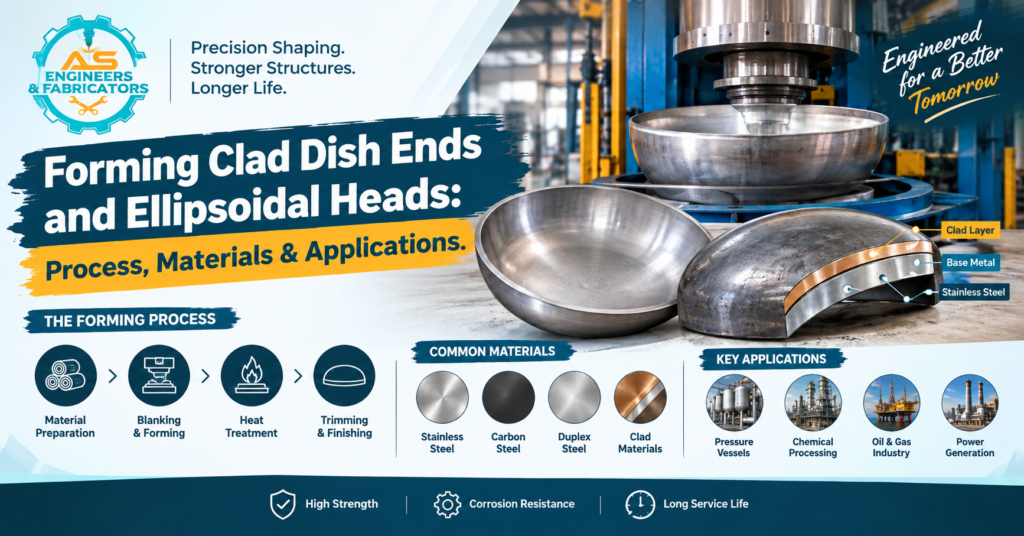
The ends of clad dishes consist of a structural backing material and a corrosion-resistant alloy layer. This construction can provide the strength required for process-side corrosion resistance to a base of carbon or low-alloy steel. The ASEFS India forming process is to maintain the required geometry and integrity of bonded materials during fabrication.
What are clad end products?
A clad dish end is a formed pressure vessel head made from a clad plate or from a bonded combination of materials.
The backing layer is typically a stronger and more economical base material, and the cladding layer is a corrosion-resistant alloy.
Depending on the application, cladding materials can be:
Stainless Steel (1.8)
Duplex stainless steels
Nickel Base Alloys
Other corrosion-resistant alloys
The backing material can be chosen according to the mechanical strength and design conditions required.
The goal is to achieve a combination of structural strength, corrosion resistance, material efficiency, and long-term service performance in one component.
Clad materials are particularly useful in applications where the process medium is corrosive, but the use of a solid corrosion-resistant alloy for the entire component would be unnecessarily expensive.
What is an ellipsoidal head?
Ellipsoidal heads are elliptically shaped curved pressure vessel closures. The 2:1 ellipsoidal head is a commonly used configuration that provides a practical balance between pressure resistance, geometry, and material efficiency.
These heads are designed for use on cylindrical pressure vessels and process equipment where a formed head is needed to resist internal or external pressure.
Ellipsoidal heads may be manufactured from:
Steel – Carbon
Low Alloy Steel
Stainless steel (
Duplex stainless steels
Nickel Alloys
Other Special Alloys
Clad Plates;
The final material and thickness are a function of the vessel design, pressure, temperature, process medium, corrosion conditions, and applicable design requirements.
For ellipsoidal and other formed pressure vessel heads, ASME Section VIII has detailed design rules.
Solid Alloy Dish Ends vs Clad Dish Ends
The decision between clad construction and solid alloy construction is based on project requirements.
Clad Dish Closing
Clad construction uses different materials for the backing and corrosion-resistant surface.
Possible benefits may include:
Surface process, corrosion resistant
Backing material: structural soundness
Less use of expensive alloy
Optimisation of materials cost
Perfect for severe process environments
Solid Alloy Dish Ends
A solid alloy head, made entirely from the corrosion-resistant alloy selected.
This is suitable where the whole component needs to have the same alloy properties or in an application where a specific homogeneous material is desired.
Selection shall be based on engineering calculations, corrosion requirements, operating conditions, fabrication requirements, and applicable standards.
Ellipsoidal Heads Manufacturing Process
The ellipsoidal heads manufacturing process requires careful control from material selection through forming, inspection, finishing, and final dimensional verification.
A typical manufacturing sequence includes the following stages.
1. Material Choice
The manufacturing process starts with choosing the required plate material.
Material is selected based on:
Design Pressure
Temperature Range
Liquid Process
Corrosion Specifications
Mechanical Properties
thickness required
Standards Applicable
Customer Spec
For clad heads, you have to consider the backing material and the cladding material.
Material certificates and heat identification are checked before manufacture.
2. Examination of Plates
The plate is inspected for visible defects and dimensional conformity prior to the formation of the plate.
Special attention may be required to the condition and integrity of the bonded interface for clad plates.
Material identification is maintained during manufacturing for traceability.
3. Shearing Blanking
Engineering dimensions. The plate is then blanked out to the required circular or segmented shape.
The blank size depends upon:
Diameter of Head
Geometry of the Head
Forming Technique
Material Thickness
Allowances forming
Allowance for Trimming
Importance of Correct Cutting: Incorrect blank dimensions can influence the final geometry and dimensional tolerances.
4. Edge Preparation
The edges of the plate are prepared for welding or further fabrication as necessary.
Edge preparation is particularly critical in segmented or crown-and-petal construction, where multiple sections must be joined accurately to each other before final forming or assembly.
5. Heating Where Required
The blank may be heated before forming, depending on the material, thickness, head diameter, and forming method.
Hot forming may be used where cold forming is not appropriate for the materials and thicknesses or where controlled forming conditions are required.
Cold forming is possible too for suitable materials and thickness ranges.
The choice of forming method is based on the material properties, thickness, geometry, capabilities of the equipment, and project requirements. In industry, the manufacturing processes include cold forming, hot forming, pressing, spinning, flanging, etc.
6. Press Forming
Press forming: The prepared plate is placed in a forming press and shaped using appropriate tooling.
Hydraulic presses can shape the plate to the desired dish profile.
Ellipsoidal heads require controlled forming to meet the specified crown and knuckle geometry.
7. Flanging & Spinning
Spinning can be used to generate the required curved profile and improve dimensional control.
Dished ends may also be produced by a combination of pressing and flanging or spinning and flanging.
The method of the forming process is selected depending on:
Diameter |
Thickness
Materials
Head Dimensions
Amount of production
Necessary Tolerances
8. Dish End Clad Forming
Clad dish ends require additional process control as two or more bonded materials are being formed together.
Different deformation characteristics of the backing material and cladding layer can be observed during forming.
The forming sequence should therefore be controlled to minimise:
Cladding cracks
Localised Stress
Surface Damage
Over-deformation
Out-of-dimension
By controlled press forming and spinning, the desired shape can be obtained while preserving the corrosion-resistant layer.
9. Trim
After forming, the head is trimmed to the specified diameter and straight face dimensions.
Adequate trimming provides proper fit-up with the shell of the pressure vessel, which is cylindrical.
10. Last Check
The final inspection verifies that the finished dish meets the approved technical requirements.
Final checks might include:
Dimensions
Surface state
Identification of materials
Weld Quality
Density
Biography
Tested Records
Documentation:
Only after the necessary inspection and paperwork can the component be prepared for shipping.
Materials Used for Clad Dish Ends
Material selection is one of the most important aspects in the manufacturing of clad pressure-vessel heads.
Backing, Carbon Steel
Carbon steel can provide the needed mechanical strength and make the whole construction economical.
Low Alloy Steel
Low-alloy steels can be chosen for specific mechanical or temperature properties.
Stainless Steel Clad
Carbon steel alone may not be suitable for some process environments, and stainless steel cladding can be used to provide corrosion resistance.
Some common options are:
SS 304
SS316L
SS316L 1.
Other Grades of Stainless
Duplex stainless steels
Duplex stainless steel provides strength and corrosion resistance for demanding applications.
Nickel Alloys
Nickel-based alloys may be selected for highly corrosive chemical environments where conventional stainless steels may not provide adequate resistance.
The final choice of the material combination shall always be based on the process medium, operating conditions, corrosion data, design requirements, and the applicable material standards.
Applications of Clad Dish Ends
Clad dish ends are used in industrial equipment where corrosion resistance and structural strength are required.
Chemical Processing
In chemical plants, they often deal with aggressive fluids, and these fluids can attack conventional carbon steel.
Cladding can provide a corrosion-resistant process surface with a suitable structural backing material.
Petrochemical Complex
Petrochemical equipment can be under high pressure, temperature, and corrosive process conditions.
Clad heads are helpful in:
20 Reactors.
Dividers
Storage Equipment
Process Vessels,
Components of Heat Exchangers
Refineries
Many hydrocarbon-processing operations employ pressure equipment and process vessels in refineries.
The selection of material is dependent on the specific process conditions and corrosion mechanisms.
Fertiliser Plants
Fertiliser production is a chemical, pressure, temperature, and corrosive process environment.
Consideration may be given to clad equipment where corrosion-resistant internal surfaces are required.
Oil & Gas and Offshore
The equipment used for offshore processing needs materials that can withstand demanding operational conditions, as well as exposure to corrosive environments.
Clad pressure vessel components can be used where the engineering design requires a corrosion-resistant internal surface.
Uses of Ellipsoidal Heads
Ellipsoidal heads are common in industry for pressure vessels and process equipment.
Pressure Vessels
Ellipsoidal heads are curved ends for cylindrical pressure vessels.
They are used in applications with gases, liquids, chemicals, and other process media.
Heat exchanger
Depending on the design configuration, the heat exchanger equipment may have formed heads or ellipsoidal heads.
Nuclear power plants
Pressure-retaining components for chemical and process reactors are required to operate under defined pressure and temperature conditions.
Storage Tanks.
Ellipsoidal heads are sometimes used in specialised storage and process vessels where a formed pressure-rated closure is required.
Process Equipment and Boilers
Formed heads are also used in boilers and other industrial equipment where pressure-containing geometry is required.
Dished ends and ellipsoidal heads are used in chemical, petrochemical, pharmaceutical, food, water treatment, power, and other processing industries.
Why Accuracy Matters in Forming
The geometry of a pressure-vessel head is not an aspect of aesthetics.
The profile formed influences:
Distribution of Stress
Pressure Tolerance
Shell fitting
Thickness of Walls
Alignment Welding
Performance of equipment
Service life
The importance of the accuracy of the geometry and design calculations is demonstrated by the fact that the ASME pressure-vessel design requirements are explicitly written for formed heads such as ellipsoidal heads.
The forming accuracy is even more important for clad dish ends, because the manufacturing process must keep the structural shape and the integrity of the corrosion-resistant layer.
Typical Problems in the Production of Clad Dish Ends
The fabrication of clad heads involves a degree of precision in the entire process.
Differential Deformation
Materials may act differently when forming different materials.
Integrity of Cladding
The corrosion-resistant layer has to be retained during the forming and subsequent fabrication.
Accuracy of Dimensions
The last head must be within tolerances for the required diameter, height, profile, and thickness.
Weld
Weld procedures and inspection need to be carefully controlled where segmented construction or attachment welding is required.
Heat Treating
Post-forming or welding, material-specific heat treatment should be considered.
Surface Condition
The surface on the process side might need to be finished, cleaned, or treated accordingly depending on the material and the application.
ASEFS India Dish End Manufacturing Capabilities
A.S. Engineers & Fabricators specialises in custom dish-end fabrication for industrial pressure vessels and process equipment.
ASEFS India produces:
Dish Ends Clad
Ellipsoidal Heads
2:1 Elliptic Heads
Torispherical Head
Hemispherical Heads
Dished Heads
Special Formed Heads
Crown and Petal Building
Custom Heads for Pressure Vessels
ASEFS India has dedicated capability for clad dish ends. The focus is on the formation of metallurgically bonded material combinations while maintaining the required geometry and corrosion-resistant surface.
ASEFS India Quality Control
Quality control is part of the manufacturing process to ensure formed heads meet the required project specifications.
Possible quality checks include:
Verification of raw material
Traceability of Materials
3D-Inspection
Profile Checking
Inspection of Welds
Visual Examination
NDT, as required
Records of Heat Treatment
Final Quality Check
Technical Documentation
Inspection requirements for international pressure vessel projects are defined by customer specifications, applicable codes, material standards, and project documentation.
ASEFS India – Why Choose Us for Clad Dish Ends & Ellipsoidal Heads?
ASEFS India combines engineering experience, heavy fabrication capability, forming expertise, and quality-driven manufacturing.
Key Strengths:
38+ Years of Engineering Experience
Ambernath MIDC, Manufacturing Unit
Customised Dish Ends Production
Dish Ends Clad Forming
Ellipsoidal Heads Manufacturing
Heavy Steel Construction
Traceability of Materials
Quality Control
Dedicated Project Fabrication
Export production
Customer Support
The company custom manufactures engineered products to customer specifications and supports industrial applications requiring custom fabrication.
ASEFS India Associated Products and Services
ASEFS India also manufactures & supplies.
Pressure Vessel
Industrial Containers
Tanks & Pipelines Lined with Rubber-lined Tanks
Dish Ends / Dished Heads
Expansion Joints
Industrial Grating
Anti-Vortex Plates
Heavy Steel Work
Steel Plant Machineries
Industrial Equipment Custom
These products support industries including chemical processing, petrochemicals, oil & gas, fertilisers, power generation, steel, water treatment, and other heavy engineering.
Connect with ASEFS India
A.S. Engineers & Fabricators (ASEFS India)
Manufacturing Plant:
Plot No. W-108/1, Anand Nagar, MIDC Ambernath East, Thane – 421506, Maharashtra, India.
WhatsApp: +91 92267 69978
Email: info@asefsindia.com
Catalogue: ASEFS India Product Catalogue
Also Read: AUTOMEX Penang 2026
Conclusion
Controlled forming, accurate material selection, dimensional inspection, and proper quality testing should be used to produce clad dish ends and ellipsoidal heads. The clad construction can combine the structural properties of a backing steel with the corrosion resistance of a suitable alloy layer. Clad material is useful for demanding chemical, petrochemical, fertiliser, refinery and process applications.
The manufacture of ellipsoidal heads is a multi-stage process with several controlled steps such as material inspection, blank preparation, forming, spinning/pressing, trimming, dimensional inspection, heat treatment if required, NDT, and final quality verification.
A.S. has more than 38 years of engineering and fabrication experience. Engineers & Fabricators (ASEFS India) is engaged in manufacturing customised dish ends, clad dish ends, ellipsoidal heads, pressure vessels, storage tanks, and other industrial fabrication products.
ASEFS India brings together fabrication expertise, material know-how, inspection capabilities and project-based manufacturing from its Ambernath MIDC facility for industrial buyers seeking customised pressure-vessel components.
Frequently Asked Questions
1. What are clad dish ends?
Ans: Clad dish ends are pressure-vessel heads made from a structural backing material bonded with a layer of corrosion-resistant alloy. They are used when there is a need for both mechanical strength and corrosion resistance.
2. The materials used for clad dish ends are:
Ans: Common combinations can include carbon or low-alloy steel backing with stainless steel, duplex stainless steel, nickel alloys, or other corrosion-resistant cladding materials. The choice depends on the process conditions and the project specifications.
3. How are the ellipsoidal heads made?
Ans: The process usually involves material selection, plate inspection, blank cutting, edge preparation, heating (if necessary), pressing or spinning, trimming, dimensional inspection, heat treatment where applicable, NDT, and final inspection.
4. What is a 2:1 ellipsoidal head?
Ans: What is a 2:1 ellipsoidal head? Ans. A formed pressure-vessel head of elliptical profile, generally used for cylindrical pressure vessels. The geometry is a pragmatic compromise between pressure resistance and material efficiency.
5. Clad dish ends are used in many different industries.
Ans: Clad dish ends can be used in applications such as chemical processing, refineries, petrochemicals, fertiliser plants, oil & gas, offshore processing, and others where the process media is corrosive.
Recent Posts
-
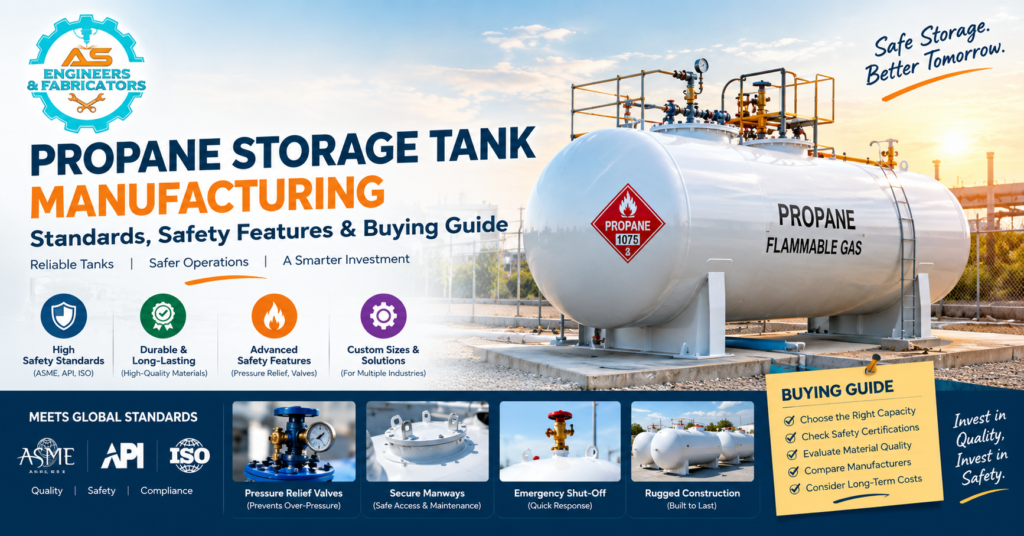 Propane Storage Tank Manufacturing: Standards, Safety Features & Buying Guide
 -
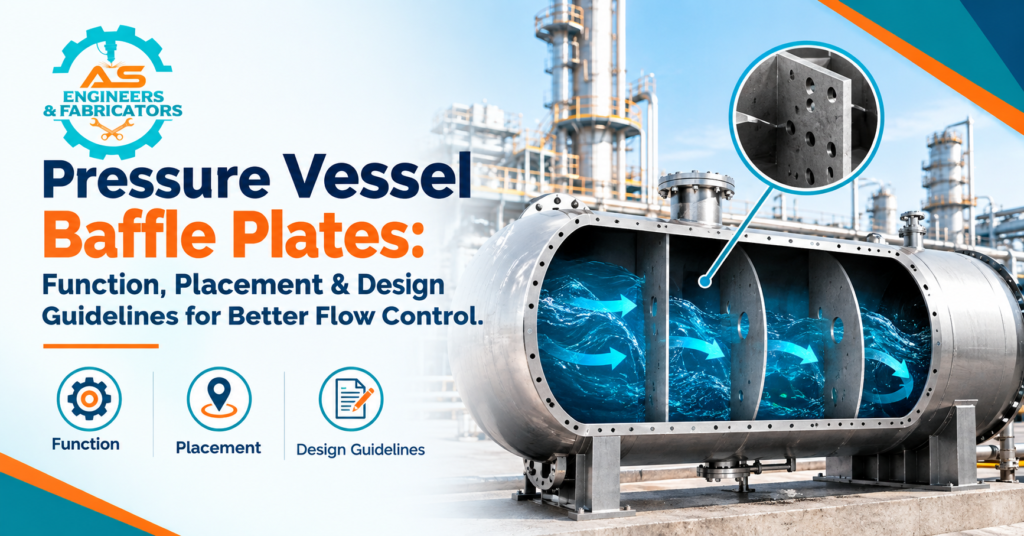 Pressure Vessel Baffle Plates: Function, Placement & Design Guidelines for Better Flow Control
 -
 Why Delrin (Acetal) Machine Parts Outperform Metal Components in Wear Applications
 -
 Delrin Sprocket Gears vs Delrin Spur Gears: Which One Fits Your Machine Design?
 -
Forming Clad Dish Ends and Ellipsoidal Heads: Process, Materials & Applications
-
 ASEFS India and Russia’s Industrial Machinery Sector: Solutions, Expertise and Opportunities
 -
 How ASEFS India Contributes to Singapore’s Industrial Machinery and Equipment Sector
 -
 Construction Indonesia 2026: Connecting Global Construction and Engineering Companies with Indonesia’s Infrastructure Market
 -
 AUTOMEX Penang 2026: Connecting Global Automation Companies with Malaysia’s Smart Manufacturing Industry
 -
 Vietnam Industrial Automation Fiesta (VIAF) 2026: Connecting Global Engineering Companies with Vietnam’s Smart Manufacturing Industry
 -
 Why Air Manifolds Improve Compressed Air Distribution in Manufacturing Plants
 -
 How to Choose the Right Air Receiver Tank for Industrial Applications
 -
 Why Rubber Expansion Bellows Are Used in Water Treatment and Chemical Plants
 -
 Machining Delrin: Tips, Advantages & Applications
 -
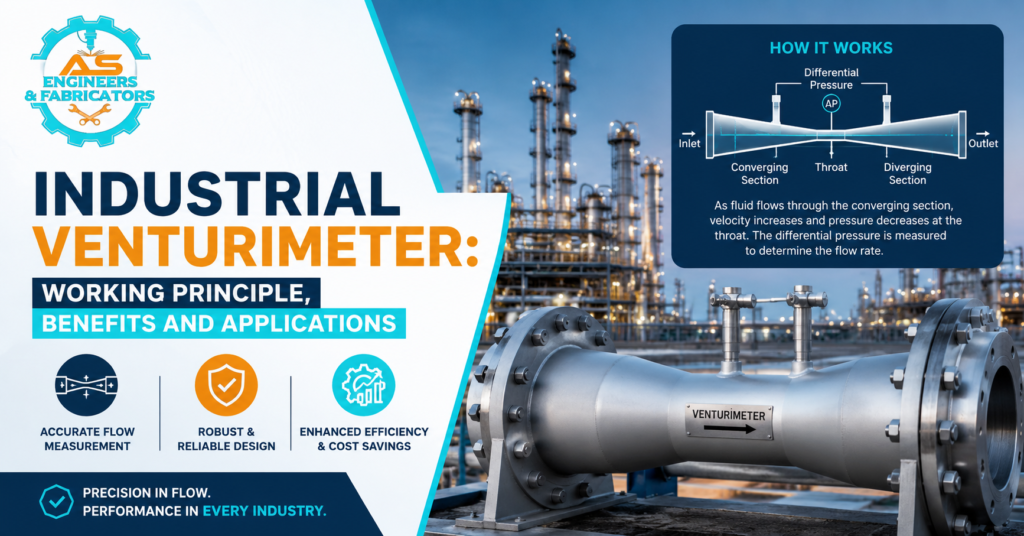 Industrial Venturimeter: Working Principle, Benefits and Applications

At A.S. Engineers & Fabricators, our team excels in designing, manufacturing, and erecting steel structures that set industry benchmarks. We have established a robust presence in metal fabrication, heavy equipment, and steel structures, providing top-tier solutions for industrial plants and high-rise buildings.