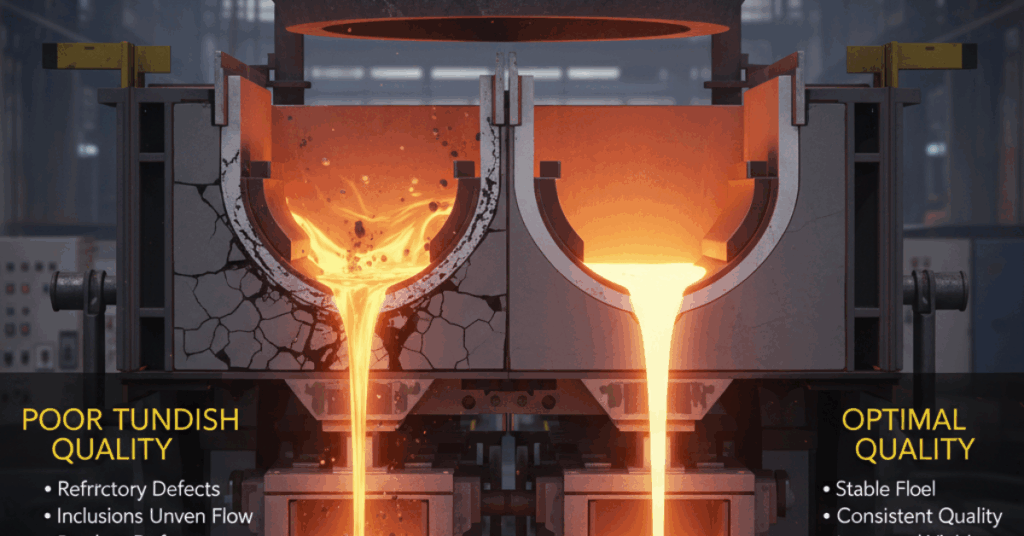
The tundish serves as the final metallurgical vessel before molten steel solidifies in continuous casting. This intermediate container sits between the ladle and the mold, acting as far more than a simple distribution point. When steelmakers talk about production quality, the condition and design of their tundish systems often make the difference between premium output and costly defects.
Modern steel plants running continuous casting operations can’t afford to treat the tundish as just another piece of equipment. Its role in removing inclusions, controlling temperature, and managing flow patterns directly impacts the cleanliness and consistency of finished products.
The tundish controls molten steel flow from the ladle to the mold while maintaining process stability. This positioning makes it a bridge between batch ladle processes and continuous operations.
Steel plants face a simple reality: quality built into steel during primary and secondary steelmaking can be lost in the tundish if not properly managed. Recovery in the mold becomes nearly impossible given the limited time steel resides there before complete solidification.
Here is why this matters. A properly functioning tundish:
From a distribution vessel, the tundish has evolved into a steel refining reactor that handles thermal and chemical homogenization. This shift has created an entirely new field called tundish metallurgy.
The tundish controls molten steel flow from the ladle to the mold while maintaining process stability. This positioning makes it a bridge between batch ladle processes and continuous operations.
Steel plants face a simple reality: quality built into steel during primary and secondary steelmaking can be lost in the tundish if not properly managed. Recovery in the mold becomes nearly impossible given the limited time steel resides there before complete solidification.
Here is why this matters. A properly functioning tundish:
From a distribution vessel, the tundish has evolved into a steel refining reactor that handles thermal and chemical homogenization. This shift has created an entirely new field called tundish metallurgy.
Also Read:- Why Galvanized Iron (GI) Remains a Top Choice for Fabrication
Non-metallic inclusions represent one of the biggest threats to steel quality. These impurities can create surface defects called slivers during rolling or cause internal stress concentrations that reduce fatigue life.
The tundish provides the last opportunity for inclusion removal. As molten steel passes through the relatively quiet environment inside, inclusions have time to float upward and separate from the bulk material.
This separation depends on several quality factors:
Companies like ASEFS India that fabricate industrial vessels understand these requirements. Their expertise in precision engineering helps steelmakers implement designs that support clean steel production through proper dimensional accuracy and material selection.
Temperature variations across casting strands create significant quality problems. The tundish helps even out temperature differences, preventing uneven cooling and solidification in the mold.
Let’s break it down. Molten steel entering the tundish may have localized hot or cold spots. Without proper mixing and retention time, strands closer to the ladle shroud receive hotter steel while distant strands run cooler. This creates:
Temperature homogenization throughout the entire melt bath results in better quality steel and more uniform casting conditions across multiple strands. The tundish lining quality plays a direct role here by maintaining proper heat retention and preventing excessive temperature drops.
Refractory Material Selection: Tundish linings use materials with low thermal conductivity to minimize heat loss while protecting steel from contamination. The insulation layer, permanent layer, and working layer each contribute to thermal management.
Baking and Preheating: Working layer dry materials need sufficient low-temperature strength obtained through proper vibration and baking. Inadequate baking creates weak spots that can collapse during casting.
The refractories lining the tundish face extreme conditions. Erosion starts at the liquid steel-air interface where level fluctuations occur, with metallic oxides in the steel acting as primary eroding agents.
Quality issues with refractory materials create cascading problems:
ASEFS India works with steel producers to fabricate tundish structures that accommodate high-performance refractory systems. Their focus on structural integrity and thermal design helps plants maximize campaign life while maintaining steel quality standards.
Multi-strand casting operations face unique challenges. Steel flowing to strands closer to the ladle shroud takes less time to arrive, creating higher temperatures and more inclusion content compared to distant strands.
This non-homogeneous distribution affects both quality and productivity. The solution lies in proper flow control devices:
The geometry and placement of these devices determine residence time distribution. Optimizing tundish flow improves mixing, eliminates dead water regions, separates inclusions, and controls temperature stratification.
Real-world tundish operations encounter specific failure modes that directly impact steel quality:
Each of these problems creates quality risks and production losses. Prevention requires attention to tundish design, refractory selection, installation practices, and operating procedures.
Also Read:- Applications of Rubber Lined Pipe Spools in Process Industries
Engineering a high-performance tundish starts with understanding the metallurgical requirements. Innovations like flow control devices, argon stirring, and advanced refractory materials have significantly improved tundish performance since the 1950s.
Key design factors include:
Fabricators like ASEFS India apply their expertise in custom vessel fabrication to support these design requirements. Their experience with pressure vessels, storage tanks, and process equipment translates well to the demanding specifications of tundish structures.
Steel producers operate on thin margins where quality problems directly impact profitability. Poor tundish performance creates costs through:
Tundish refractories constitute high specific costs in continuous casting operations. Plants need these materials to support long casting sequences, faster turnaround times, and higher campaign life while maintaining steel cleanliness.
The investment in quality tundish systems pays back through:
Next steps for steel plants looking to improve tundish performance include auditing current refractory practices, evaluating flow control devices, reviewing baking procedures, and working with experienced fabricators on any structural improvements needed.
The steel industry continues pushing for better quality and efficiency. Modern tundish systems incorporate advanced sensors and automated control systems that enable real-time adjustments in flow rate, temperature, and composition monitoring.
Emerging developments include:
These advances build on the fundamental principle that tundish quality determines steel quality. As customer requirements become more demanding, the importance of proper tundish design, operation, and maintenance only increases.
What is the primary purpose of a tundish in continuous casting?
The tundish acts as an intermediate vessel between the ladle and mold, serving multiple purposes beyond simple distribution. It provides continuous steel flow during ladle changes, removes non-metallic inclusions through flotation, homogenizes temperature and composition, and controls the flow rate to casting molds. This makes it the last metallurgical vessel where steel quality can be improved before solidification.
How does tundish quality affect steel cleanliness?
Tundish quality directly impacts steel cleanliness through several mechanisms. Poor refractory lining can introduce new inclusions through erosion and chemical reactions. Inadequate flow control prevents proper inclusion flotation and removal. Temperature control issues affect slag chemistry and inclusion behavior. A properly designed and maintained tundish removes inclusions that formed in earlier processing steps while preventing new contamination.
What are the most common tundish quality problems?
Common problems include refractory lining erosion and penetration, nozzle clogging from inclusion buildup, turbulator floating due to density mismatches or improper installation, thermal cracking in nozzles and linings, and insufficient baking causing weak spots in working layers. These issues reduce campaign life, force production interruptions, and compromise steel quality through increased inclusions and temperature variations.
Why is refractory material selection critical for tundish performance?
Refractory materials must withstand extreme thermal and chemical conditions while preventing steel contamination. They need high resistance to molten steel and slag corrosion, excellent thermal shock resistance to prevent cracking when contacting liquid metal, low thermal conductivity for heat retention, and minimal thermal expansion to maintain lining integrity. Poor material selection leads to shorter campaign life, increased inclusions, and temperature control problems.
How can steel plants improve their tundish operations?
Improvements start with proper refractory selection and installation practices, including adequate baking to achieve design strength. Flow control devices should be optimized through modeling or physical testing. Regular monitoring of lining condition, temperature patterns, and inclusion levels helps identify problems early. Working with experienced fabricators like ASEFS India on tundish structure quality ensures proper dimensional accuracy and thermal design that supports long-term performance.



At A.S. Engineers & Fabricators, our team excels in designing, manufacturing, and erecting steel structures that set industry benchmarks. We have established a robust presence in metal fabrication, heavy equipment, and steel structures, providing top-tier solutions for industrial plants and high-rise buildings.
+91 92267 69978
+91 89569 38780
info@asefsindia.com
2025 © A.S Engineers - All rights reserved