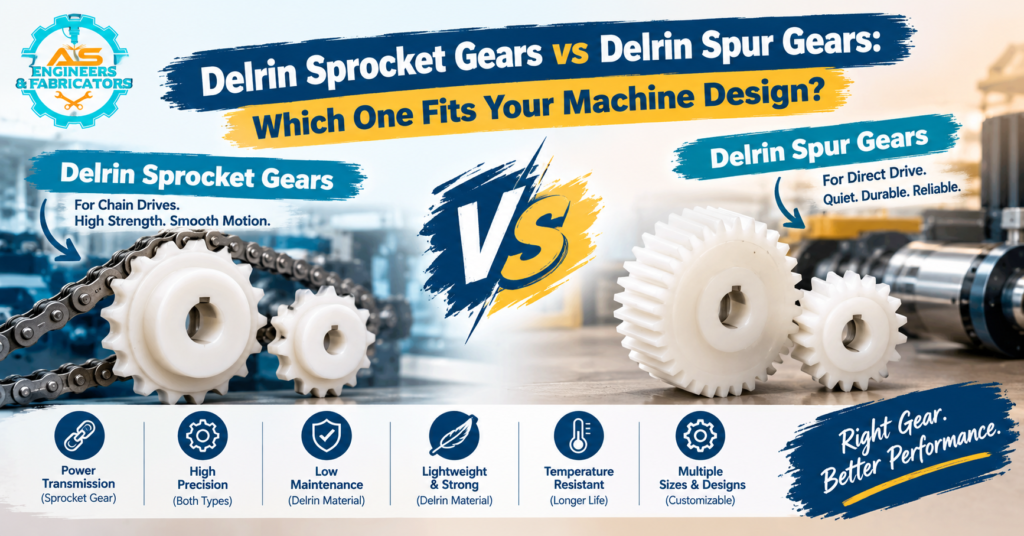
Delrin Sprocket Gears vs Delrin Spur Gears: Which One Fits Your Machine Design?
By A.S. Engineers & Fabricators Technical Team, 38+ Years, Ambernath MIDC, Maharashtra. Selection of the proper gear type is one of the key aspects of machine design. Poor gear profiles can result in inefficient power transmission, increased wear, pressure vessels, alignment issues, noise, water treatment, or early component failure. When engineers want lightweight, low-friction, dimensionally stable plastic gears, two of the options they often consider are Delrin sprocket gears and Delrin spur gears.
Both are made of Delrin, a trade name often used for acetal homopolymer materials. They are designed for different gearbox configurations. A sprocket engages a chain; a spur gear engages directly with another gear.
Understanding the difference between a Delrin sprocket gear and a Delrin spur gear allows engineers to choose the right component for the machine’s drive mechanism, load, speed, operating environment, and maintenance requirements.
Also Read: Construction Indonesia 2026
What is a Delrin sprocket?
A Delrin sprocket gear is a toothed wheel that engages with a chain. Unlike a normal gear, it does not transmit motion by direct gear meshing. Instead, the sprocket pushes rotation through a chain loop.
Delrin is appropriate for applications where designers require:
Low friction
Lightweight parts
Good stability in dimensions
Low water absorption
Resistance to corrosion
Less noise in operation
Good machining characteristics
Needs little maintenance
Delrin sprocket gears are utilised in conveyor systems, indexing mechanisms, material handling equipment, packaging machinery, and other machines that employ chain-driven motion.
What is a spur gear Delrin?
Delrin Spur gear: A spur gear is a cylindrical gear with straight teeth parallel to the gear axis. It transmits rotational motion by direct meshing with another spur gear.
The usual way of arranging spur gears is to have one driving gear and one driven gear. The tooth profiles mesh with each other to transmit torque and change the speed or direction of rotation.
Delrin spur gears are frequently specified where designers require:
Smooth mechanical gear changes
Low noise operation
Lightweight gears
Low friction
Corrosion-resistant parts
Less lube needed
Repetitive, precise motion
They’re in small machinery, automation systems, instruments, actuators, office equipment, and many kinds of mechanical assemblies.
Delrin Sprocket Gear vs Delrin Spur Gear: Main Difference
The key difference is in how the motion is transmitted in each component.
Feature | Delrin Sprocket Gear | Delrin Spur Gear |
Transmission method | Chain drive | Direct gear-to-gear meshing |
Mates with | Roller or other compatible chain | Another compatible gear |
Drive arrangement | Chain and sprocket system | Gear train |
Typical application | Conveyors, chain drives, indexing systems | Machinery, automation, instruments |
Centre distance | Can accommodate larger distances through chain length | Generally limited by gear pair geometry |
Lubrication | Depends on chain and operating conditions | Depends on load, speed and material |
Noise | Chain engagement can produce noise. | Plastic gears can offer relatively quiet operation. |
Maintenance | Chain tension and alignment are important. | Tooth engagement and alignment are important. |
Design flexibility | Useful for longer shaft-to-shaft distances | Useful for compact gear trains |
The right choice is more about which component is better for the mechanical architecture of the machine than which is better overall.
How Delrin Sprocket Gears Function
A sprocket is a wheel with teeth shaped to match the chain. The driving sprocket turns, its teeth engaging the links of the chain and driving the chain forward. The chain then carries the motion to another sprocket.
This arrangement has an important design advantage: the shafts can be farther apart than would normally be practical with a simple gear pair.
For instance, a motor may have to drive a shaft some several hundred mm away, or more, from the shaft being driven, as in the case of a conveyor. A chain and sprocket arrangement can span this distance without the need for a very large gear train.
Where You Can Benefit From Delrin Sprockets
Delrin sprockets can be considered for applications such as.
Transport systems
Machines for packaging
Material handling equipment
Chain-drive mechanisms
Indexing systems
Light-duty automation
Food processing equipment, when suitable material specifications are achieved
Mechanical drives are small.
The exact suitability depends on chain size, tooth geometry, torque, speed, temperature, and environmental conditions.
Operation of Delrin Spur Gears
Spur gear operation is based on direct tooth engagement. The driving gear rotates, and its teeth mesh with those of the driven gear to transmit rotary motion.
The gears can be chosen in ratio to increase torque, decrease speed, increase speed, or keep some particular ratio of rotation.
For example, the use of a smaller driving gear to mesh with a larger driven gear reduces the output speed and increases the available torque, within the limits of the mechanical efficiency and load.
Applications for Delrin Spur Gears
Common use cases include.
Mini Gearboxes
Automation equipment
Mechanisms of Robotics
Equipment
Office and computing machines, printers
Actuators >
Light-duty mechanisms and pumps
Industrial control equipment
Mechanical positioning devices
Delrin spur gears are particularly suitable where the transmission of direct power in a compact manner is required.
When to Choose a Delrin Sprocket Gear?
The Delrin sprocket is usually more suitable when the machine already has one or will work better with a chain gearbox system. Think about a sprocket when.
1. The Shafts Are So Far Apart
Chain drives can take larger centre distances without having to make the gear too large.
2. The Conveyor Machine Uses
Chains and sprockets are used extensively in conveyor and material handling systems to transmit power and motion.
3. A Flexible Drive Layout You Need
The chain allows positioning of the drive and driven shafts according to the layout of the machine.
4. The ease of replacement is important.
Sprockets are a replaceable individual component, properly designed with accessible chain drive assemblies.
5. The application needs to be lightweight.
Delrin has a lower density than metals, which can help reduce rotating mass in appropriate applications.
When Should One Use a Delrin Spur Gear?
If the machine needs a direct gearbox from gear to gear, then a Delrin spur gear is usually suitable. Consider a spur gear if.
1. Need For Compact Transmission
A gear pair can transmit motion directly from shaft to shaft without the need for a chain loop.
2. The exact speed ratio matters.
The ratio of the number of teeth on the driving and driven gears gives the basic gear ratio.
3. The Machine Uses a Gear Train
A Delrin spur gear can fit into the existing gearbox architecture if the design already has multiple gears.
4. The value of being light
Plastic gearing can reduce the mass of moving parts for suitable low- to moderate-load applications.
5. We want less noise.
Delrin gears can be quieter than some metal gear arrangements, although actual noise depends on tooth profile, speed, load, alignment, and machine structure.
Features to Consider When Selecting Delrin Gears
Don’t choose a Delrin sprocket gear over a Delrin spur gear just because of the shape. Engineers have to consider the entire operating environment.
Loading & torque
Determine the continuous and peak torque that the component shall transmit. Shock loads should also be considered.
Speed of Rotation
High-speed operation leads to an increase in friction, heat generation, and wear. The gear or sprocket should be determined by the actual operating speed.
Heat
Delrin has a specified operating temperature range. The material and design evaluation for applications at elevated temperatures needs to be carefully considered.
Chemical and Water Exposure
Acetal materials offer good dimensional stability compared to many other plastics, but chemical compatibility still needs to be verified with the actual operating environment.
Clothing Guidelines
Service life is a function of the expected duty cycle, contact pressure, speed, and lubrication conditions.
Dimensional precision
The tooth geometry, pitch, bore sizes, concentricity, and overall tolerances are important factors in providing a reliable mechanical gearbox.
Mounting and Arrangement of Shaft
The chain must be correctly aligned on the sprocket, and the centre distance and tooth engagement must be correct on the spur gear.
Delrin Spur Gear vs. Delrin Sprocket Gear – Machine Design
If you look at the transmission architecture, the decision can be made easier.
Choosing a Delrin sprocket gear:
This is a chain-driven machine.
Shafts are pretty far away.
Conveyor or material handling motion required.
The system requires a flexible shaft assembly.
In the machine design, the gearbox is already chain-based.
When to use a Delrin spur gear:
Two shafts that must be geared directly to each other.
A compact gear train is needed.
You need a specific gear ratio.
The application uses direct power transmission by rotation.
Low-weight gearing is advantageous.
Neither component should be chosen without checking the actual torque, speed, tooth geometry, operating temperature, and expected service life.
Why Industrial Gears and Sprockets? Use Delrin.
Acetal materials provide useful mechanical properties with relatively low weight. These are popular in many mechanical applications. Some of the major benefits are.
Low Friction
Its frictional characteristics can be exploited to reduce resistance in suitable applications.
Dimensional Stability
Stable dimensions are critical for consistent tooth engagement and mechanical alignment.
Resistance to corrosion
Unlike conventional steel parts, Delrin doesn’t rust, so it can be used in environments where corrosion resistance is needed.
Lightweight Build
Where the application permits, component weight can be reduced by replacing metal parts with engineered plastic.
Machineability
Delrin can be machined into precise gear and sprocket profiles with proper manufacturing processes.
Lower Noise
Depending on the complete assembly, plastic gear teeth can be quieter than some metal gear systems.
Things to Remember in Manufacturing: Delrin Gears and Sprockets
Gear performance is directly affected by manufacturing accuracy.
Key factors to consider include:
Material grade selection
Sprocket or gear profile
Teeth spacing.
Number of teeth
Diameter bore diameter
Mounting arrangement or keyway
Reciprocity
Width of tooth
Tolerances of dimensions
Surface finishing
Inspection requirements
For special industrial components, the manufacturing drawing should specify dimensions, tolerances, material requirements, and mounting details clearly.
If the design and volume of production justify it, CNC machining is a good way to create precision plastic parts. For bigger quantities of production, moulding processes can also be considered depending on the geometry of the component and the requirements of the project.
Uses of Delrin Sprocket and Spur Gears
Both types of components can be found in industrial and mechanical equipment. However, according to their gearbox method, they are used for different applications.
Applications for Delrin Sprocket
Drives for conveyors
Packaging machinery.
Machine chain-driven
Handling systems
Indexing structures
Light-duty industrial automation
Applications of Delrin Spur Gears
Automation System
Small gearboxes
Instrumentation
Robotics &
Actuators /
Printing.
Mechanical positioning units
Light-duty gearbox systems
The application should always be verified with the material and load specifications of the manufacturer.
Custom Delrin Gear Production
Industrial machinery doesn’t always use standard off-the-shelf gear sizes. You may require custom components for a specific shaft, chain, gearbox, or machine assembly.
Your custom Delrin gear and sprocket requirements may also include:
Custom OD
Exact number of teeth
Unique pitch
Bore custom
Keyway
Modification of hub
Special mounting arrangement
Dimensional, close tolerances
Prototype amounts
Output volumes
For custom industrial fabrication and engineering requirements, detailed drawings and application specifications are helpful to manufacturers in determining the appropriate method of production.
Precision Plastic Gearing Quality Control
Quality inspection is very important because even small dimensional errors can affect the meshing of gears and the performance of the gearbox.
Common areas to be inspected may include:
Material check.
Checking dimensions
Bore gauge measurement
Tooth profile examination
Concentricity (
Pitch precision
Finish of surface
Eye inspection
Functional fitment wherever required
The inspection requirements are to be established according to the operating conditions and engineering specifications of the machine.
Connect with ASEFS India
A.S. Engineers & Fabricators (ASEFS India)
Manufacturing Plant:
Plot No. W-108/1, Anand Nagar, MIDC Ambernath East, Thane – 421506, Maharashtra, India.
WhatsApp: +91 92267 69978
Email: info@asefsindia.com
Catalogue: ASEFS India Product Catalogue
Also Read: How ASEFS India Contributes to Singapore’s Industrial Machinery and Equipment Sector
Conclusion
Understanding the Delrin sprocket gear vs Delrin spur gear difference begins with the gearbox method. A sprocket is designed to be used with a chain and is therefore well suited to chain-driven systems and applications where shafts need to be further apart. A spur gear is a gear that meshes directly with another gear and is better suited for compact gear trains and direct gear transmission of rotation.
The final choice for the machine designer has to consider torque, speed, centre distance, rubber-lined tanks, dish ends operating temperature, wear, dimensional accuracy, mounting arrangement, and expected duty cycle. Choosing the correct Delrin part during the design phase can help create a more reliable and effective mechanical system.
A.S. Engineers & Fabricators ASEFS India, Ambernath MIDC, and Maharashtra Industrial Solutions that include fabrication, engineering, and manufacturing for custom components and heavy industrial equipment. Prior to fabrication, technical drawings and operating parameters should be evaluated for application-specific requirements.
Frequently Asked Questions
1. What is the difference between a Delrin sprocket gear and a Delrin spur gear?
Ans: Motion is transmitted by a Delrin sprocket via a chain or by direct contact of a meshing gear with a Delrin spur gear.
2. Are Delrin sprocket gears suitable for conveyor systems?
Ans: They may be suitable for some light-duty conveyor and chain-driven applications. Prior to selection, chain size, load, speed, temperature, and operating conditions must be taken into account.
3. Where are spur gears made of Delrin® used?
Ans: They can be used in automation equipment, instrumentation, small gearboxes, actuators, robotics, and other mechanical systems that need direct gear transmission.
4. Delrin gears are not as heavy as metal gears.
Ans: Yup. Delrin is much less dense than most engineering metals, so parts made from Delrin can reduce the weight of suitable mechanical assemblies.
5. Do Delrin gears require lubrication?
Ans: Lubrication requirements differ with material combination, load, speed, and environment of operation. Many Delrin gear applications can be run with little or no additional lubrication, but the specific design should be evaluated.
Recent Posts
-
Delrin Sprocket Gears vs Delrin Spur Gears: Which One Fits Your Machine Design?
-
 Forming Clad Dish Ends and Ellipsoidal Heads: Process, Materials & Applications
 -
 ASEFS India and Russia’s Industrial Machinery Sector: Solutions, Expertise and Opportunities
 -
 How ASEFS India Contributes to Singapore’s Industrial Machinery and Equipment Sector
 -
 Construction Indonesia 2026: Connecting Global Construction and Engineering Companies with Indonesia’s Infrastructure Market
 -
 AUTOMEX Penang 2026: Connecting Global Automation Companies with Malaysia’s Smart Manufacturing Industry
 -
 Vietnam Industrial Automation Fiesta (VIAF) 2026: Connecting Global Engineering Companies with Vietnam’s Smart Manufacturing Industry
 -
 Why Air Manifolds Improve Compressed Air Distribution in Manufacturing Plants
 -
 How to Choose the Right Air Receiver Tank for Industrial Applications
 -
 Why Rubber Expansion Bellows Are Used in Water Treatment and Chemical Plants
 -
 Machining Delrin: Tips, Advantages & Applications
 -
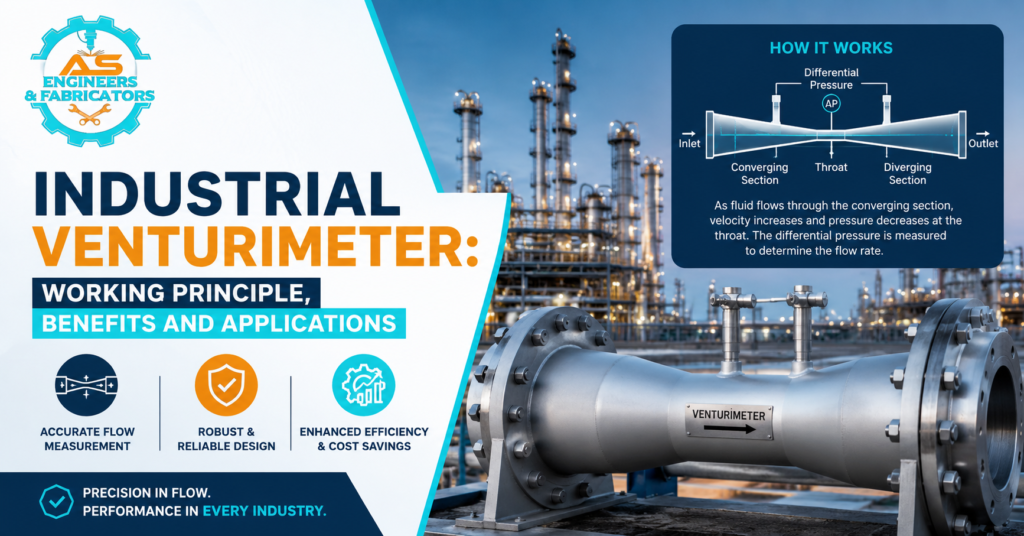 Industrial Venturimeter: Working Principle, Benefits and Applications
 -
 Why do industries in Iran Import Industrial Venturi Tubes from India for Accurate Flow Measurement
 -
 Why Global Industries Choose Indian Venturi Tube Manufacturers for Water, Steam, Oil & Gas Flow Measurement
 -
 Industrial Venturi Tube Manufacturer in India: Exporting High-Accuracy Flow Meters to Iran, UAE, Saudi Arabia & Global Markets

At A.S. Engineers & Fabricators, our team excels in designing, manufacturing, and erecting steel structures that set industry benchmarks. We have established a robust presence in metal fabrication, heavy equipment, and steel structures, providing top-tier solutions for industrial plants and high-rise buildings.