Industrial piping systems frequently operate in harsh environments with frequent temperature fluctuations, vibration, pressure variations, and mechanical movement. To ensure structural stability and prevent pipeline damage, engineers install expansion bellows in industrial pipelines to help isolate and control movement.
Industrial bellows help protect critical equipment and maintain a safe plant environment. Selecting the appropriate bellows is critical because each industrial setting has distinct needs. Rubber expansion bellows and metal expansion bellows are two of the most common types of bellows used in industrial pipelines. Both types of bellows function similarly to flexible connectors that control movement in industrial pipes. But they have very different characteristics and are meant to function in various industrial environments.
Manufacturers and suppliers of piping system components, industrial fabrication solutions, and engineering services, like ASEFS India, often offer both of these bellows to satisfy industrial demand.
To choose the best option for long-term stability, it is necessary to distinguish between rubber and metal expansion bellows.
Expansion bellows are flexible connectors used in pipelines to absorb movement. These bellows are corrugated or flexible portions fitted between pipe joints to protect equipment and isolate movement.
Industrial plants with extensive piping networks are built to last for years. Pipes that transport hot fluids are frequently found in industrial plants. Heat causes these pipes to expand, resulting in unwanted movement. Without expansion control devices, this shifting causes pipe deformation, equipment failure, or flange joint leakage.
Engineering companies that offer steel fabrication services, piping fabrication solutions, and industrial engineering support, like ASEFS India, often design expansion bellows into pipe networks to ensure structural safety and operational efficiency.
Also Read:- Why Galvanized Iron (GI) Remains a Top Choice for Fabrication
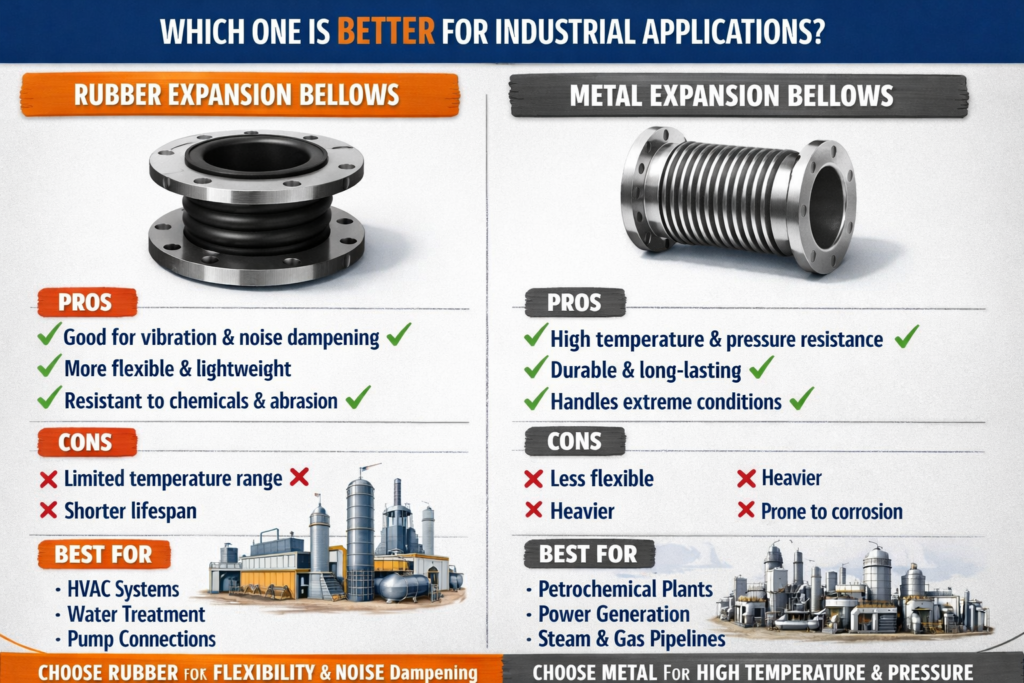
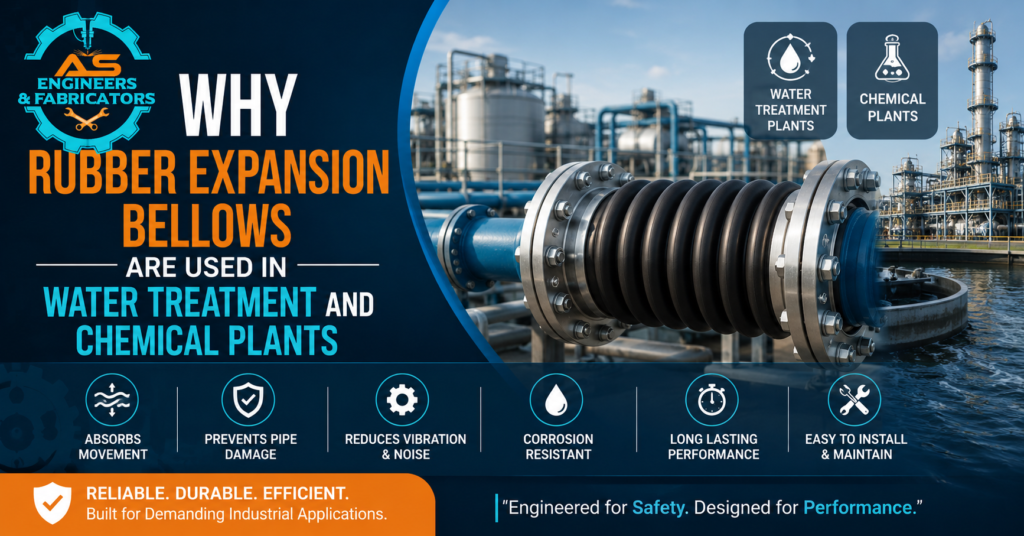
Rubber expansion bellows are flexible connectors made of elastomer material with synthetic fabric reinforcement or steel rings. They are commonly employed in situations that call for vibration isolation and moderate pressure.
Rubber expansion bellows are popular in water treatment facilities, HVAC systems, cooling pipelines, and pump connections because rubber absorbs vibration and noise naturally.
Rubber bellows are used to manage multiple types of motion within a pipeline system. They can absorb axial expansion and compression, lateral movement, angular displacement, and vibration from rotating equipment.
Rubber bellows are made of rubber materials such as EPDM, neoprene, nitrile, and natural rubber to withstand specific fluids and operating circumstances.
Industrial fabrication service providers, rubber lining of tanks, piping system components suppliers, and industrial maintenance solution providers like ASEFS India, frequently supply rubber expansion bellows for systems that must control vibration.
Rubber bellows perform several functions in industrial piping systems.
These benefits explain why rubber bellows are often seen in industrial sectors that handle water circulation, cooling systems, and HVAC pipelines.
Industrial fabrication companies that supply steel structures, industrial tank fabrication, piping fabrication services, and process equipment manufacturing solutions, such as ASEFS India, often advise the use of rubber bellows in moderate-pressure systems requiring vibration control.
Metal expansion bellows are flexible piping components made of stainless steel or alloy metal. These bellows are frequently manufactured in corrugated shapes that allow controlled motion while maintaining strength.
Metal bellows are frequently used in high-temperature and high-pressure industrial settings where rubber materials cannot survive.
Oil and gas plants, petrochemical facilities, power generation plants, steam pipeline systems, and industrial process equipment are among the typical sectors that use metal expansion bellows.
Industrial fabrication, steel fabrication services, pressure vessel components, and piping engineering solutions providers, like ASEFS India, are well-known for supplying metal bellows for critical industrial installations.
Metal bellows are designed to last in harsh industrial settings.
Metal expansion bellows are used in a variety of steam systems, chemical plants, and refinery pipelines because of these characteristics.
Industrial fabrication companies such as ASEFS India, which provide steel fabrication, industrial piping solutions, pressure vessel fabrication, and structural engineering services, design metal bellows to meet stringent industrial standards.
Both types of bellows perform the same primary role, but perform differently depending on the operating circumstances.
The decision is mostly based on system temperature, pressure, and vibration demands.
Industrial fabrication solution suppliers, piping engineering service providers, and industrial equipment manufacturing firms like ASEFS India, for example, aid clients in selecting the appropriate expansion joint based on project requirements.
Expansion bellows are used in a variety of industrial settings.
Metal bellows are widely employed in refinery pipelines and petrochemical plants.
Steam pipelines need metal bellows to manage extreme temperatures.
Rubber bellows are frequently installed in water treatment facilities to dampen vibration and sound.
Rubber bellows can be found in heating and cooling systems, protecting pumps and compressors.
Rubber and metal bellows are both used in chemical processing plants, depending on chemical compatibility and temperature.
Industrial fabrication services, steel structural fabrication, piping system services, and expansion joint suppliers, such as ASEFS India, for example, support these industries with dependable engineering solutions.
Determining the correct expansion bellows requires consideration of a few engineering criteria.
Operating temperature, pressure level, fluid type, vibration level, pipeline size, and installation environment are among the most crucial considerations.
Rubber bellows are typically preferred in water pipelines and vibration-sensitive systems, while metal bellows are chosen for high-temperature industrial pipelines and steam systems.
Engineering companies such as ASEFS India, which provide industrial fabrication, piping system services, structural steel solutions, and equipment manufacturing, assist industries in selecting the most suitable expansion joint for long-term performance.
Also Read:- What Are ASME-Certified Pressure Vessels and Why They Matter in India
Expansion bellows are essential industrial piping system components since they absorb thermal expansion and contraction, dampen vibration, and protect equipment from mechanical stress. Rubber and metal bellows both have unique advantages depending on the operating conditions.
Rubber expansion bellows are a good choice in systems where vibration isolation, flexibility, and noise reduction are required. Metal expansion bellows are a better choice for high-temperature and high-pressure industrial applications.
Expansion bellows can help to dramatically improve pipeline safety and operating efficiency with the correct engineering design and installation. Companies that provide industrial fabrication solutions, steel structures, piping fabrication services, and engineering equipment manufacturing, like ASEFS India, provide reliable expansion bellows designed to support industrial infrastructure for the long term.
Ans: Rubber bellows are better suited for vibration isolation and moderate conditions, whereas metal bellows are designed for high-temperature and high-pressure applications.
Ans: Rubber expansion bellows are typically found in HVAC systems, water pipelines, pump connections, and cooling systems.
Ans: Metal bellows are widely used in oil and gas plants, power stations, chemical processing facilities, and steam pipelines.
Ans: They absorb thermal expansion, vibration, and mechanical movement to prevent stress damage to pipelines and equipment.
Ans: Yes, expansion bellows can be customized for industrial projects. Manufacturers such as ASEFS India offer customized expansion bellows designed to the requirements of the pipeline size, pressure rating, and application.




At A.S. Engineers & Fabricators, our team excels in designing, manufacturing, and erecting steel structures that set industry benchmarks. We have established a robust presence in metal fabrication, heavy equipment, and steel structures, providing top-tier solutions for industrial plants and high-rise buildings.
+91 92267 69978
+91 89569 38780
info@asefsindia.com
2025 © A.S Engineers - All rights reserved