Compressor Valve Plate Manufacturer and Exporter in India: Uses and Benefits
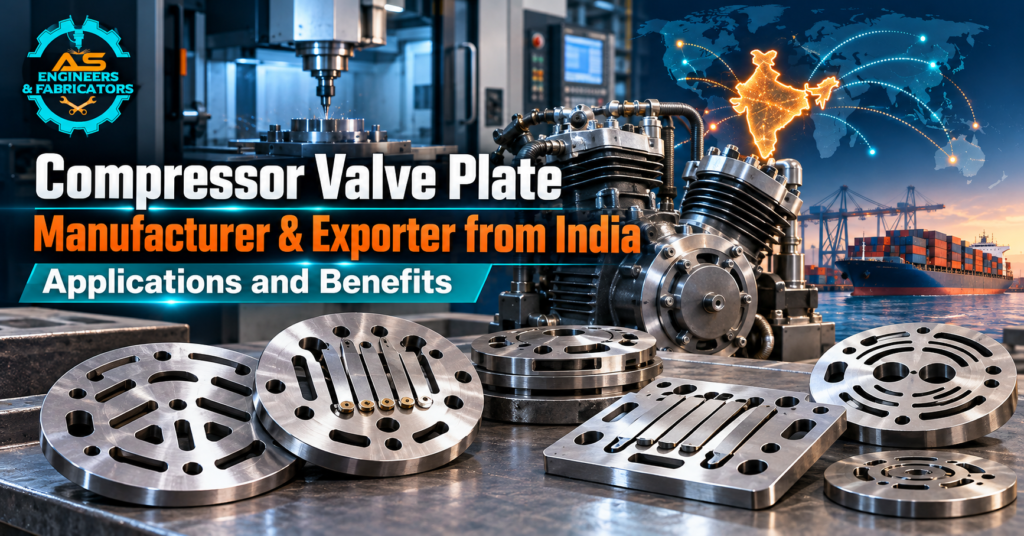
The design and condition of a compressor valve plate can impact the performance of a whole reciprocating compressor even if it is a small part. By A.S. Engineers & Fabricators Technical Team | Ambernath MIDC, Maharashtra. Good sealing, proper flow passages, and reliable valve movement allow the machine to perform its intended air or gas duty.
For buyers looking for a compressor valve plate manufacturer & exporter from India, the selection process should begin with the compressor model, component drawing, and operating conditions. A physical replacement may not be suitable for the service required.
Valve selection is an application-specific engineering task that compressor manufacturers consider. Ariel identifies plate mass, pressure vessels, lift, dish ends, spring force, and materials as coordinated design inputs.
This guide describes compressor valve plate applications, potential benefits, material considerations, and the information required for a manufacturing inquiry. It also provides guidance on how to discuss custom industrial machinery components and export requirements with A.S. ASEFS India (Engineers & Fabricators).
Also Read: How to Import industrial products from India – Step-by-Step Guide
What is a valve plate for a compressor?
The term “valve plate” can mean different things depending on the compressor design.
In a plate-type reciprocating compressor valve, it is the moving sealing element. In some refrigeration compressor designs, it is a rigid ported plate associated with suction and discharge valve elements.
Identify the exact component
Description | Role | Information to confirm |
Moving sealing plate | Opens and closes flow passages within a valve | Profile, thickness, material and valve configuration |
Ported valve plate | Provides passages and seating features in a particular compressor design | Model, port layout, seating details and associated parts |
Complete valve assembly | Combines the components needed for the specified valve function | Assembly reference, configuration and supply scope |
BITZER’s spare-parts information highlights valve-seat design and controlled valve-plate thickness, while process-compressor manufacturers describe separate metallic and non-metallic sealing plates.
A photo alone may not identify the correct part. Refer to the compressor data sheet and drawing where applicable.
How Compressor Discharge and Suction Valves Work
Suction and discharge valves in a reciprocating compressor regulate the flow of gas through the cylinder during the compression cycle.
When the pressure difference is right, the suction valve opens, and gas comes in. The discharge valve allows compressed gas to escape from the cylinder. Their closing action prevents backflow.
Ariel refers to the compressor valves as finely tuned check valves. The configuration is selected according to desired pressures, gas characteristics, speed, and operating range.
Why the difference is important to procurement
The suction and discharge components are not interchangeable. Please include valve duty, cylinder or stage, and part reference with your inquiry.
Have the compressor specialist review the valve configuration before ordering a copy of the existing component if the operating conditions have changed.
Compressor Valve Plate Applications
Valve plates are associated with certain reciprocating compressor designs. These are not the common components for all compressor technology.
Industrial Air Compressors
Plate valves are suitable for industrial air applications, such as high-pressure air systems. The exact part depends on the compressor and duty.
Compression of Natural Gas
Reciprocating natural gas compressors employ special plate-valve designs. The choice of material and valve dynamics should be compatible with the given gas and operational conditions.
GAS COMPRESSION FOR PROCESS GAS
In chemical and process installations, reciprocating compressors with plate-type valves can be used. The inquiry should identify the full composition of gas, relevant contaminants, and service requirements.
Refrigeration Systems
The valve-plate arrangement of some reciprocating refrigeration compressors has model-specific suction and discharge features. Refrigerant, lubricant, and compressor type are important pieces of identification information.
Specialist Air Systems & Marine
OEM plate-valve applications include marine starting air, PET bottle blowing and industrial gases. These examples are illustrative of the range of possible duties, not interchangeability between them.
Advantages of Properly Specified Compressor Valve Plates
The benefits are derived from the operation of the valve system, including its plate, seat, springs, and associated components.
Effective Seal
A plate that meets the required geometry and surface properties will achieve the desired sealing function.
Leakage performance should be assessed at assembly level. Simply replacing the plate may not fix a problem of a worn seat, damaged spring, or other assembly defect.
Proper flow performance
The gas flow path depends on the valve geometry. Valve motion control and OEM profiled plate designs are developed to improve flow characteristics.
That is not to say that making the valve lift more or making the openings bigger would necessarily make an existing valve better. Changes require assessment of the whole design.
Reliable Repetition
Compressor valves are exposed to cyclic loading and significant mechanical stress. The choice of suitable material and configuration helps support the required service duty.
Improved Maintenance Scheduling
Repeat procurement is ensured with clear part identification, inspection records, and an approved replacement specification.
There is no one percentage of energy savings or service-life improvement that applies to all replacement plates. Performance is dependent on the compressor, operating conditions, and condition of the complete assembly.
Material Selection for Compressor Valve Plates
There is no one best material for all valve plates.
The OEM product line includes steel plate valves and non-metallic designs. Material selection should be consistent with the approved component design and operating envelope.
Material category | Selection considerations |
Metallic plate materials | Specified grade, condition, fatigue requirements, surface quality and compatibility |
Engineered polymer materials | Exact grade, temperature capability, gas compatibility and dynamic performance |
Reinforced or modified polymers | Filler system, orientation or processing requirements, and validated application data |
For instance, the documentation for Ariel’s CP/CPs states that the design uses a carbon-filled PEEK plate. This is an application-specific example, not a generic specification for all compressor plates.
Do not substitute by the name of the material only.
“Steel”, “plastic”, or even a polymer family name is far too broad for a critical replacement. Enter the approved grade and processing condition.
Because a material is good for a guide roller or a gear doesn’t mean it is good for compressor valve duty. Any proposed substitute should be technically reviewed against the service it is intended for.
What Operating Conditions Should Buyers Provide?
A detailed operating specification helps the manufacturer and compressor specialist evaluate the request.
You will need to include:
Compressor serial number, make, model, and stage.
Suction or discharge valve servicing.
Composition of gas or refrigerant.
Normal and maximum operating pressure;
Operating temperature.
Expected operating range and compressor speed.
Non-lubricated or lubricated service.
Relevant history of operations and contaminants.
Differentiate between normal operation, design limits, and temporary excursions.
Provide a failure history of the part if it has failed repeatedly and the drawing. A revised operating duty may call for a valve review instead of repeated manufacture of the same plate.
Requirements for Precision Engineering and Manufacturing
Compressor valve plates need a well-controlled production process that is adapted to the approved material and geometry.
The process can be different for a thin metallic sealing plate, a profiled polymer element, and a rigid ported plate. The drawing should state the essential result, not leave it to the reader’s imagination.
A practical manufacturing inquiry should determine:
The approved component drawing and revision.
Requirements for material grade, condition and traceability.
Critical thickness, profile and seating size.
Surface and edge condition necessary.
Processing and inspection requirements, where applicable.
First article approval and repeat batch provisions.
Protection of functional features
Design inspection shall specify the port edges, sealing areas, and locating features to which attention shall be paid.
Do not accept a waterjet-cut or laser-cut outline as a finished valve plate unless the other manufacturing and acceptance criteria are verified. The component determines the required path.
Compressor Valve Plate Inspection & Testing
Production inspection must be agreed upon and recorded on the purchase specification.
Parts Examination
Depending on the drawing, checks may include.
identification of material.
Measurements of thickness and profile
Flatness or shape defined.
Port and locating-hole locations.
Surface finishing and edge quality.
Material-specific properties or tests as required.
Assembly Level Checks
A dimensional inspection report is not a performance of a complete valve.
If the supply includes an assembly, agree on the checks required for the seat, springs, lift, assembly condition, and leakage performance. Burckhardt’s valve service information outlines the inspection of components, proper assembly, and leakage testing as separate activities.
Acceptance criteria shall be from the approved specification or applicable OEM requirements. Don’t assume a pressure test is appropriate for all loose valve plates.
Replacement Parts: Why You Can’t Just Use a Matching Outline
Two plates can have the same outside diameter but be different in function.
The operation of a valve can be affected by its thickness, mass, profile, port arrangement, and material. The choice of the right gasket or associated assembly parts may also depend on the compressor version.
If you are asking for a replacement, please also give the part number and assembly reference together with dimensions. Indicate whether the request is for a loose plate, a repair kit, or a complete valve.
Working with a Sample
An existing sample can be used to identify a component, but a worn or damaged sample may not reflect the original dimensions.
Determine how the design will be established and who will approve it before manufacture. Reverse engineering should not only involve copying visible features but also a technical assessment.
Failure Analysis and Maintenance
Where a damaged plate is to be replaced, a review of the operating and assembly conditions should be carried out.
Provide inspection pictures, service time, and any recent changes to compressor operation. The maintenance team should find the cause by referring to the relevant compressor instructions.
Possible areas of review are seat condition, springs, assembly details, contamination and operation outside the expected envelope. Ariel suggests reviewing valve selection when operating conditions differ from those used for the original configuration.
All dismantling, inspection, and reassembly should be carried out according to the compressor manufacturer’s isolation and maintenance procedures.
Keep part records and service history so that recurring failures can be compared meaningfully.
How to Select a Compressor Valve Plate Manufacturer in India
A good supplier evaluation depends on the particular component and the duties being accepted.
Scope of Work
Determine if the supplier manufactures to an approved drawing, supplies a replacement design, or supplies a complete valve.
Materials and Process Control
Ask how the material identity, critical process steps, and acceptance of finished parts will be determined.
Inspection Report
Agree on dimensions and other characteristics to be reported. Specify if independent inspection or witnessed checks are required.
Approval & Compatibility
Find out who approves the replacement of the intended compressor. The ability of a manufacturer to build it doesn’t mean it will work with every OEM model.
Repeat Delivery
Use the approved material record, part number, and controlled drawing revision for future orders.
These questions allow buyers to compare industrial manufacturing solutions on a specific technical basis.
International Buyers Export Requirements
Agree component specifications and delivery arrangements for an overseas order.
Confirm quantity, destination of delivery, named terms of delivery, packaging and required documents. Clearly mark different revisions or separate suction and discharge parts in the shipment.
Machining and sealing surfaces must be protected against the handling conditions to be expected during transport. Before dispatch, specify material certificates, inspection reports, and other agreed records.
Lead time, minimum order quantity, freight cost and documentation are subject to actual order. Confirm them in the quote, rather than take for granted a standard export package.
ASEFS India Engineering & Fabrication Capabilities
A.S. Engineers & Fabricators is engaged in custom engineering, precision machining, industrial spares, and export capabilities. Its website states that it has more than 38 years of industry experience.
Send drawings, approved material & compressor service details for the compressor valve plate inquiry. Before placing your order, verify the exact manufacturing capability, technical responsibility, and inspection scope.
This separates an inquiry about a custom component from a claim of universal compressor compatibility or OEM approval.
Compressor Valve Plate: Request a Quote
Send.
Component drawing, part number and revision.
Compressor model, serial number and assembly reference.
Suction or discharge duty and stage.
Approved material specification.
Quantity and delivery schedule.
Pressures, temperatures, speed and gas composition.
Critical tolerances and inspection requirements.
Scope: loose plate, repair kit or assembly.
Delivery destination and documentation needs.
A.S. Engineers & Fabricators ASEFS India
Address: Plot No. W-108/1, Anand Nagar, Additional MIDC, Ambernath East, Thane – 421506, Maharashtra, India.
Phone: +91 92267 69978
Email: info@asefsindia.com
Website: asefsindia.com
Also Read: Delrin Cable Rollers Manufacturer & Exporter from India for Industrial Applications
Conclusion
Valve plates in compressors are used to support the sealing and flow functions of particular designs of reciprocating compressors. The advantages are conditional on correct identification, approved materials, water treatment, appropriate geometry, a rubber-lined tank, and the state of the entire valve assembly.
When you are selecting a compressor valve plate manufacturer & exporter from India, you need to specify the component and its operating needs before checking quotes. Kindly share the technical documentation for ASEFS India enquiries for us to confirm the available manufacturing and export scope.
Q&A
1. What is a compressor valve plate used for?
Ans: Depending on the design, it may be a moving sealing element or a ported plate associated with the compressor’s valve arrangement.
2. Can the suction valve plate be exchanged with the discharge valve plate?
Ans: Don’t assume they are. Verify duty, compressor model, part number, and assembly configuration.
3. What is the best compressor valve plate material?
Ans: Design and service are based on the approved material. Metallic and engineered polymer plates are used in many OEM valve configurations.
4. Can a valve plate be made from a sample?
Ans: A sample can help with ID, but wear condition and missing specs need to be addressed. Design and sign off before manufacture.
5. Will the plate change save compressor energy consumption?
Ans: It can help restore performance when a bad plate causes a problem. So it is a function of the total state of the valve and compressor, and no constant savings can be taken for granted.
Recent Posts
-
Compressor Valve Plate Manufacturer and Exporter in India: Uses and Benefits
-
 Delrin Cable Rollers Manufacturer & Exporter from India for Industrial Applications
-
 How to Import Industrial Products from India – Step-by-Step Guide
-
 Delrin Parts Manufacturer & Exporter from India for Drones and Robotics
-
 Best Dish End Shapes for Corrosion-Resistant Tanks and Reactors
-
 Propane Storage Tank Manufacturing: Standards, Safety Features & Buying Guide
-
 Pressure Vessel Baffle Plates: Function, Placement & Design Guidelines for Better Flow Control
-
 Why Delrin (Acetal) Machine Parts Outperform Metal Components in Wear Applications
-
 Delrin Sprocket Gears vs Delrin Spur Gears: Which One Fits Your Machine Design?
-
 Forming Clad Dish Ends and Ellipsoidal Heads: Process, Materials & Applications
-
 ASEFS India and Russia’s Industrial Machinery Sector: Solutions, Expertise and Opportunities
-
 How ASEFS India Contributes to Singapore’s Industrial Machinery and Equipment Sector
-
 Construction Indonesia 2026: Connecting Global Construction and Engineering Companies with Indonesia’s Infrastructure Market
-
 AUTOMEX Penang 2026: Connecting Global Automation Companies with Malaysia’s Smart Manufacturing Industry
-
 Vietnam Industrial Automation Fiesta (VIAF) 2026: Connecting Global Engineering Companies with Vietnam’s Smart Manufacturing Industry

At A.S. Engineers & Fabricators, our team excels in designing, manufacturing, and erecting steel structures that set industry benchmarks. We have established a robust presence in metal fabrication, heavy equipment, and steel structures, providing top-tier solutions for industrial plants and high-rise buildings.