
Propane Storage Tank Manufacturing: Standards, Safety Features & Buying Guide
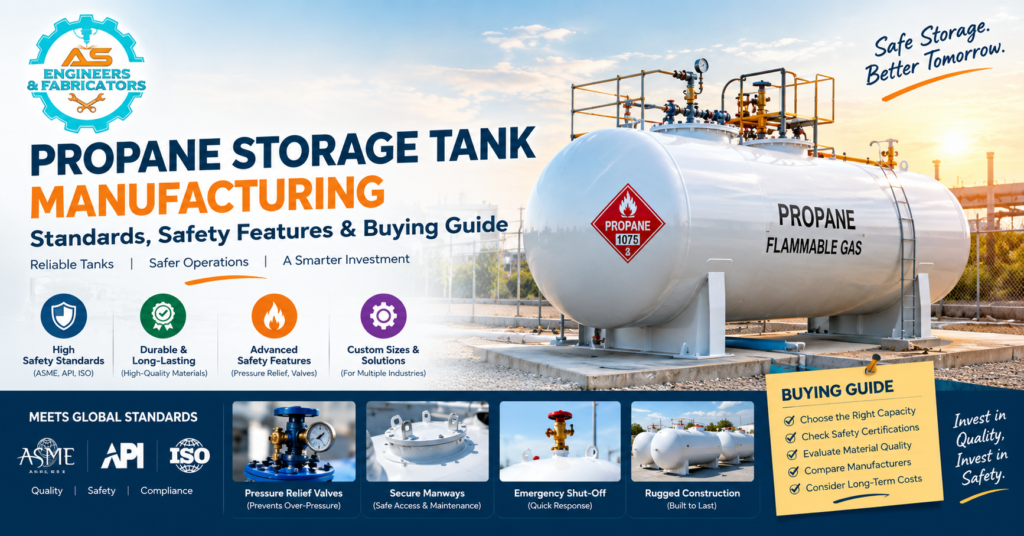
By A.S. Engineers & Fabricators Technical Team, 38+ Years, Ambernath MIDC, Maharashtra. Propane is a flammable liquefied gas and needs carefully engineered storage systems. Industrial facilities using propane as a fuel for process applications, heating, chemical manufacturing, or other industrial operations require storage vessels designed for the pressure, temperature, material compatibility, and operating conditions of the service.
A propane storage tank is a pressure vessel that stores propane in liquid form at a controlled pressure and temperature. Propane is a flammable pressurised product, and therefore tank design, fabrication, inspection, installation, fittings, safety systems, and periodic testing are all important considerations.
A. S. Ambernath MIDC, Maharashtra, is a manufacturer and supplier of customised pressure vessels and industrial fabrication solutions for demanding applications. With over 38 years of experience in engineering and fabrication, ASEFS India manufactures pressure vessels, storage tanks, dish ends, industrial equipment, and other fabricated items as per project specifications.
For propane storage tank manufacturers in India, the important aspect is not just tank capacity or price. The vessel shall be designed and constructed to meet applicable design requirements, statutory regulations, material specifications, inspection requirements, and site conditions.
Also Read: Why Delrin (Acetal) Machine Parts Outperform Metal Components in Wear Applications
Propane Storage Tank: What Is It?
A propane storage tank is a pressure vessel for storing propane in liquid form.
Propane is usually stored as a liquid under pressure. The liquid propane vaporises when the pressure is lowered and can be supplied to the intended process or fuel system.
Industrial propane storage systems can vary widely in:
Storage Size
Diameter of Vessel
Vessel Lengths
Preliminary.
Design Loads
Design Temp.
Installation Preferences
Material Description
Pipe Layout
Safety Instrumentation
The proper tank configuration is application- and site-specific.
Where is a propane storage tank used?
Various industrial sectors employ propane storage tanks.
Industrial Fuel Systems
Propane can be used in manufacturing facilities as fuel for heating systems, furnaces, boilers, burners, and other approved equipment.
Process & Chemical Industries
Depending on the facility, propane can be used as a feedstock, fuel, or process-related gas.
Gas Distribution and LPG
Propane storage systems may be incorporated into industrial gas storage and distribution facilities.
Commercial and Food Processing
Propane is suitable for thermal applications when the related fuel system and safety requirements are met.
Industrial Remote Facilities
If you don’t have continuous natural-gas delivery, propane storage can give you a fuel supply.
The design of the tank and the installation itself always have to be based on the real operating conditions and legal requirements.
Manufacturing Process of Propane Storage Tank
Fabrication of a pressure vessel for propane service shall be controlled from material selection through final inspection.
1. Review Design & Engineering
The manufacturing process starts with establishing the design requirements.
Important parameters are:
Capacity of Storage
Pressure to Design
Design Temperature
Working Pressure
Operating Temperature
Orientation of Vessel
Material Spec.
Allowance for Corrosion
Nozzle specifications
Service Agreement
Relevant Codes and Regulations
The design basis shall be established before the start of fabrication.
ASME Section VIII sets forth requirements for pressure-vessel design, materials, fabrication, inspection, and testing for pressure vessels designed to ASME requirements.
2. Choice of Materials
The choice of materials is important in pressure-vessel manufacturing.
Depending on the design code, temperature, pressure, toughness requirements, and project specifications, suitable carbon steels or other approved pressure-vessel materials may be used.
Material certificates and heat numbers should be kept for traceability.
3. Cutting Plates
Approved engineering drawings are used to cut pressure-vessel plates.
The cutting process has to consider:
Vessel Diameter
Shell Length
Head Size
Thickness of Plates
Weld joint design
Fabrication Tolerances
Correct cutting provides correct shell assembly and dimensional control.
4. Rolling and Forming of Shells
Cylindrical propane vessels are manufactured from rolled steel plates of specified diameter.
The rolled sections are lined up and ready to be welded.
Dimensional inspection is made to verify:
Diameter
Roundness
Alignment
Size
Fit-Up, Joint
5. End Manufacturing
The vessel heads shall conform to an approved design.
Depending on the design, the vessel may employ:
Ellipsoidal Head
Torispherical Head
Other Approved Formed Heads
The design specification in effect governs the head thickness, profile, diameter, and forming requirements.
6. Weld
Shell courses, heads, nozzles, supports and other pressure retaining parts are welded in accordance with approved welding procedures.
Important controls for welding are:
Welding Qualification Procedures
Certified Welders
Preheat as necessary
Management of Interpass Temperatures
Control of Welding Consumables
Weld ID
Visual Check
Non-Destructive Examination
The required inspection level shall be taken from the applicable code and project specification.
7. Nozzle & Fitting Installation
Propane storage vessels must have connections for filling, withdrawal, pressure relief, instrumentation, drainage, and other functions.
The exact arrangement of nozzles depends on the design and installation of the vessel.
8. NDT
NDT can be used to detect potential defects that cannot be seen by visual inspection only.
Inspection methods may include, depending upon design and applicable requirements:
Ultrasonics Testing
Radiographic Testing
Magnetic Particle Inspection
Liquid Penetrant Inspection
Visual Examination
The amount of NDT to be done shall be in accordance with the applicable code and project specifications.
9. Hydrostatic Testing
Pressure testing is carried out in accordance with the relevant design code and regulatory requirements.
The method of testing and pressure shall be established by the approved engineering documentation and applicable statutory requirements.
10. Surface Preparation and Coatings
The exterior surface may require proper surface preparation and protective coating.
Selection of coating depends on:
Weather Elements
Site Environment
Corrosive Exposure
Configuration de l’installation
Customer Needs
Underground or mounded installations may require additional corrosion protection.
Propane Storage Tank Standards and Regulations in India
Regulatory compliance plays a major role in installing a propane storage vessel in India.
The Petroleum and Explosives Safety Organization (PESO) implements the Static and Mobile Pressure Vessels (Unfired) Rules, 2016, which specify requirements for pressure vessels used for transportation and storage of compressed gases. SMPV(U) rules and subsequent amendments are now listed on the official PESO website.
The published guidance of PESO also specifically names LPG and propane as gases that can be stored in underground or mounded pressure vessels under the relevant provisions.
Confirm applicable regulatory requirements with the responsible designer, statutory authority and inspection agency for a particular project.
Design of Pressure Vessels Code
Depending on the project specification and statutory requirements, the design of a pressure vessel may be governed by recognised pressure vessel codes such as ASME Section VIII.
ASME Section VIII includes requirements for pressure-vessel design, materials, fabrication, inspection and testing.
The exact code base should be determined during engineering, not just from the product name.
PESO clearance
The approval, fabrication, installation, inspection and operation of pressure vessels covered by the SMPV(U) Rules may be subject to PESO requirements.
PESO’s current guidance states that the manufacture of pressure vessels and fittings must have prior approval from the Chief Controller under the relevant regulatory regime.
Buyers should check the approval process for their specific propane storage project before manufacture or installation.
Important Safety Features of Propane Storage Tanks
Safety equipment is an integral part of a propane storage installation.
Pressure-relief valves
Pressure relief devices are furnished to protect the vessel against overpressure in specified abnormal conditions.
The size, installation, set pressure, discharge arrangement, and number of relief devices shall conform to applicable design and regulatory requirements.
PESO has published requirements for certain LPG storage installations, including safety relief provisions and periodic testing requirements.
Level Measurement
Operators can see how much propane is in the vessel by the level indication.
Depending on the installation, independent level indication and high-level protection may be necessary.
Isolation Valves
Isolation valves permit parts of the system to be isolated for maintenance or emergencies.
Overfill Protection
Excess-flow protection helps limit the release of propane in the event of an abnormal flow condition.
Remote Operated Valves
Some LPG installations have to have remotely operated valves fitted to some liquid and vapour connections.
Review the specific installation for applicable regulatory requirements. PESO’s published rules contain remote-operated valve requirements for some LPG storage configurations.
Earthing and Bonding
Appropriate earthing and bonding arrangements are required to control electrical and static-related hazards.
Emergency Shutdown
Depending on the design of the installation and the regulations that apply, industrial propane installations may require emergency isolation and shutdown systems.
Fire Protection
Design of fire protection systems shall be based on storage configuration, quantity, site layout, applicable standards and statutory requirements.
Aboveground, Underground and Mounded Propane Storage
The installation method may significantly impact the design and safety specifications of the tank.
Aboveground Storage
Aboveground tanks are accessible for inspection and maintenance.
May be required:
Separation distances;
Fire Protection
Safety Valves;
Access Arrangements
Corrosion Protection
Emergency Systems
Storage Underground
Underground installation may provide an alternative exposure profile, but additional requirements are imposed regarding the following.
Corrosion Control
Cathodic Protection
Buoyancy of Tank
Accessibility
Inspection
Pipe
Drainage.
Mounded Storage
Mounded vessels are located under an engineered earth cover.
PESO’s published requirements contain specific requirements for underground and mounded LPG storage vessels, including corrosion protection, safety relief-valve discharge arrangements, inspection, and related installation requirements.
The correct configuration will need to be determined by project-specific engineering and regulatory review.
Design Considerations for Propane Storage Tanks
Proper engineering is the foundation of a safe propane tank.
Design Pressure
Design pressure shall be based upon anticipated operating conditions and applicable design requirements.
Temperature Design
Temperature influences material properties and pressure conditions. The design temperature has to be fixed during the engineering.
Corrosion Allowance
The needed corrosion allowance is a function of the material, the environment, the service conditions, and the expected life.
Vessel Dimensions
The required capacity should be calculated from.
Rate of Consumption
Frequency of delivery
Storage Strategy –
Vapour Requirement
Site Limitations
Operating Reserve Requirement
Nozzle Configuration
The vessel shall be equipped with suitable connections for.
Refilling
Liquid Extraction
Withdrawal of vapour
Release Pressure
Level gauging
Drainage Systems
Equipment.
The approved design shall provide the actual arrangement.
Buying Guide for Propane Storage Tank
There’s more to choosing a propane storage tank than just looking at prices.
1. Determine the Required Capacity
Find out what the facility needs in propane.
Both oversising and undersising can cause operational or economic problems.
2. Design Condition Check
Request the manufacturer for the design pressure and temperature and the design basis used.
3. Kindly confirm material specifications.
The material of the vessel shall be suitable for the service intended and shall comply with the applicable design requirements.
4. Inspection and Testing – Ask Us!
Buyers shall be informed of the extent of inspection and testing before ordering.
This may involve:
Material Inspection
Inspection of Welds
NDT
Dimensional Inspection.
Pressure Testing
Last inspection
Documentation
5. Review Regulatory Requirements
For India-based projects, check applicable PESO and other statutory requirements before procurement.
Under the SMPV(U) framework, PESO’s existing guidelines contain provisions for licensing, approval, inspection, and testing of pressure vessels.
6. See Documentation
Important project documents might include.
Approved Sketch
Material Certificates
Weld Records
NDT Report
Pressure Test Record
Certificates of Inspection
Manufacturing Data
End of documentation
7. Evaluate the manufacturer’s experience.
The manufacturers should have appropriate experience in pressure-vessel fabrication, welding, inspection, and project documentation.
Why choose ASEFS India for pressure vessel fabrication?
A.S. Engineers & Fabricators has been in the business of engineering and fabrication for more than 38 years and is located at Ambernath MIDC, Maharashtra.
ASEFS India offers customised industrial fabrication solutions as per project specifications.
Manufacturing capabilities are:
Pressure Vessels
Tanks-Storage Industrial
Propane/LPG pressure vessels, including approvals and project requirements as applicable
End of Dish
Heads, Spherical
End Clad Pot
Reactors.
Heat Transfer Components
Heavy Steelwork Fabrication
Process Equipment – Industrial
Key strengths are:
38+ years of experience
Custom Engineered
Pressure Vessel Manufacturing
Precision Welds
Traceability of Material
NDT Co-ordination
Quality Assurance
Project Documentations
Manufacturing for export
Final design, manufacturing, inspection, approval, and installation requirements should be developed for regulated propane storage applications under the applicable statutory framework and project specification.
Quality Control in ASEFS India
Every stage of the manufacture of pressure vessels has built-in quality control.
Standard quality checks could include:
Materials Verification
Material tracking
Inspection of Plate Thickness
Inspection of Dimensions
Inspector, Welding
Visual Inspection
NDT
Pressure Test
Surface Inspection
Final Documentation
The precise inspection plan may vary depending upon the applicable code, customer specification, inspection authority, and project requirements.
Other Products & Services of ASEFS India
ASEFS India also manufactures & supplies.
Pressure Vessel
Storage Tanks for Industry
Dish Ends / Dished Heads
Ellipsoidal Heads
Dish End Clad
Expansion Joints
Rubber-lined tanks & pipes
Industrial Gratings
Anti-Vortex Plates
Heavy Steel Structures
STEEL PLANT MACHINERY
These products are used in the chemical processing, petrochemicals, oil & gas, fertiliser, power generation, water treatment, steel, and other process industries.
Connect with ASEFS India
A.S. Engineers & Fabricators (ASEFS India)
Manufacturing Plant:
Plot No. W-108/1, Anand Nagar, MIDC Ambernath East, Thane – 421506, Maharashtra, India.
WhatsApp: +91 92267 69978
Email: info@asefsindia.com
Catalogue: ASEFS India Product Catalogue
Also Read: Pressure Vessel Baffle Plates: Function, Placement & Design Guidelines for Better Flow Control
Conclusion
Propane is a flammable liquefied gas stored under pressure. Propane has to be stored in carefully engineered pressure vessels. Tank design must take into consideration capacity, pressure, temperature, materials, protection against corrosion, relief systems, valves, instrumentation, installation configuration, inspection and applicable statutory requirements.
Engineering and procurement must consider applicable amendments to the SMPV(U) Rules, 2016, PESO requirements, and the pressure-vessel design code for projects in India. PESO’s published material deals specifically with pressure-vessel design, fittings, periodic testing, static installations and other requirements under the SMPV(U) regime.
If you are a buyer looking for a propane storage tank manufacturer in India, your selection should be based on the engineering capability, experience in pressure-vessel fabrication, quality control, documentation, inspection arrangements, and ability to meet the applicable regulatory requirements.
A. S. ASEFS India (Engineers & Fabricators) has more than 38 years of experience in engineering and fabrication. The company offers customised pressure-vessel and industrial fabrication solutions from its Ambernath MIDC facility in Maharashtra.
FAQs
1. What is propane tank storage?
Ans: Propane storage tank A propane storage tank is a pressure vessel used to store propane in its liquid state under controlled pressure and temperature conditions.
2. What are the specifications of propane storage tanks in India?
Ans: Requirements vary according to installation and project. PESO administers the Static and Mobile Pressure Vessels (Unfired) Rules, 2016, and applicable amendments, which are significant regulatory references for pressure vessels within their scope. The engineering basis may also include recognised pressure-vessel design codes such as ASME Section VIII as specified.
3. Propane tank pressure relief?
Ans: Yes. Relieving pressure is an important part of storing pressurised propane. The number, sizing, set pressure, installation, and discharge arrangement shall be determined in accordance with applicable design and regulatory requirements.
4. Can propane be stored in underground or mounded tanks?
Ans: “Yes.” PESO has issued provisions in SMPV (U) which specifically address the underground and mound storage of LPG or propane and lay down additional requirements for such installations.
5. Materials for the construction of propane storage tanks are as follows:
Ans: The selection of appropriate pressure-vessel steels is generally made based on the applicable design code, pressure, temperature, toughness, corrosion considerations, and project specification.
Recent Posts
-
Propane Storage Tank Manufacturing: Standards, Safety Features & Buying Guide
-
 Pressure Vessel Baffle Plates: Function, Placement & Design Guidelines for Better Flow Control
 -
 Why Delrin (Acetal) Machine Parts Outperform Metal Components in Wear Applications
 -
 Delrin Sprocket Gears vs Delrin Spur Gears: Which One Fits Your Machine Design?
 -
 Forming Clad Dish Ends and Ellipsoidal Heads: Process, Materials & Applications
 -
 ASEFS India and Russia’s Industrial Machinery Sector: Solutions, Expertise and Opportunities
 -
 How ASEFS India Contributes to Singapore’s Industrial Machinery and Equipment Sector
 -
 Construction Indonesia 2026: Connecting Global Construction and Engineering Companies with Indonesia’s Infrastructure Market
 -
 AUTOMEX Penang 2026: Connecting Global Automation Companies with Malaysia’s Smart Manufacturing Industry
 -
 Vietnam Industrial Automation Fiesta (VIAF) 2026: Connecting Global Engineering Companies with Vietnam’s Smart Manufacturing Industry
 -
 Why Air Manifolds Improve Compressed Air Distribution in Manufacturing Plants
 -
 How to Choose the Right Air Receiver Tank for Industrial Applications
 -
 Why Rubber Expansion Bellows Are Used in Water Treatment and Chemical Plants
 -
 Machining Delrin: Tips, Advantages & Applications
 -
 Industrial Venturimeter: Working Principle, Benefits and Applications

At A.S. Engineers & Fabricators, our team excels in designing, manufacturing, and erecting steel structures that set industry benchmarks. We have established a robust presence in metal fabrication, heavy equipment, and steel structures, providing top-tier solutions for industrial plants and high-rise buildings.