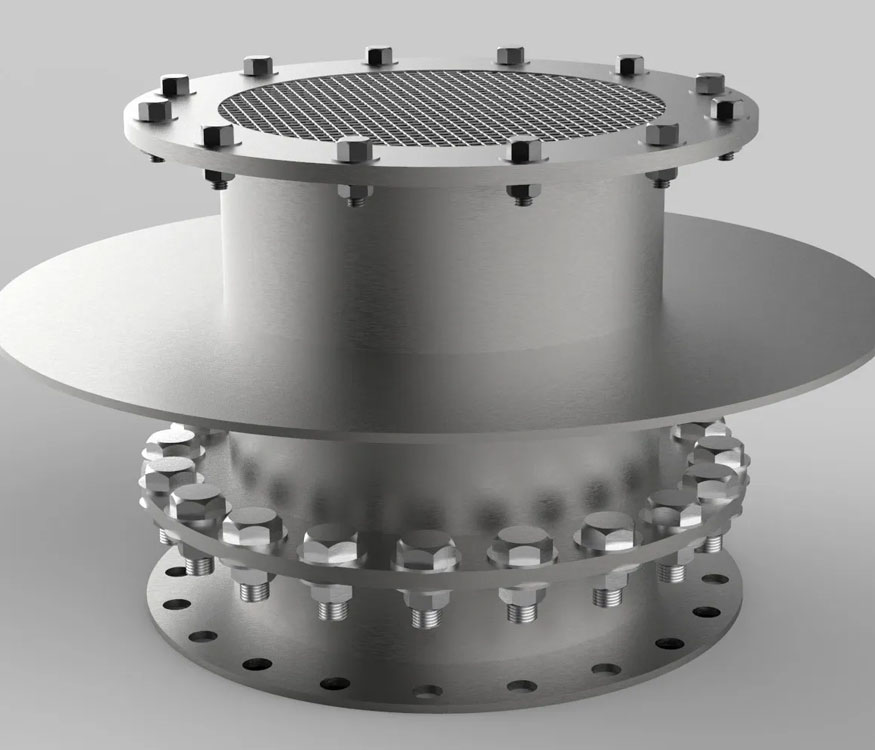
An anti-vortex plate is a simple mechanical device that is installed inside a tank or vessel, just above the outlet nozzle, to prevent vortex formation during liquid discharge. This common accessory is used in storage tanks, process vessels, pump suction lines, and separator systems where uncontrolled vortexing can cause operational problems. Industrial applications often source these components from Asefs India.
To understand how an anti-vortex plate works, it is important to first understand what a vortex is and why it forms.
What Is a Vortex in a Tank?
When liquid drains from a tank through a bottom outlet, the fluid accelerates towards the outlet nozzle. If the liquid level in the tank is low or the discharge rate is high, the liquid begins to rotate around the outlet in a swirling motion.
The spinning liquid forms a whirlpool effect, which is known as a vortex. The vortex becomes stronger as the discharge continues.
When a vortex becomes strong enough, it can start to entrain air or vapor from the liquid surface, pulling it down into the outlet line.
This can cause a number of problems, such as:
- Air entrainment in pump suction
- Cavitation
- Flow instability
- Reduced pump efficiency
- Noise and vibration
- Inaccurate flow measurement
In oil and gas, chemical processing, and water treatment systems, these issues can lead to equipment damage, process upsets, and even safety hazards. To minimize such risks, engineered solutions from manufacturers like Asefs India are widely used.
Also Read:- How Metalizing Extends the Life of Industrial Structures and Equipment
Basic Principle of an Anti-Vortex Plate
An anti-vortex plate works by disrupting the rotational flow pattern that leads to vortex formation. Instead of allowing liquid to spin freely above the outlet nozzle, the plate blocks the swirling motion of the fluid and forces it to flow in a more radial, or evenly distributed, pattern.
In other words, an anti-vortex plate breaks up the circular flow of liquid that is necessary for a vortex to fully develop. Properly designed anti-vortex plates supplied by Asefs India are engineered to achieve this effect efficiently.
How the Plate Is Installed:
- An anti-vortex plate is usually mounted horizontally, above the outlet nozzle, in the vessel.
- It is positioned a short distance from the tank bottom, with the flat plate facing the outlet.
- Anti-vortex plates are typically fixed in place using support brackets or welded lugs.
The spacing between the anti-vortex plate and the outlet nozzle is an important design consideration, and is typically based on the outlet diameter, flow rate, liquid properties, and tank geometry. Engineering teams at Asefs India carefully evaluate these parameters during fabrication.
The Installation Purpose
As shown in the figure below, breaking the circular motion of the liquid flow, it keeps the air away from the liquid suction. Installation guidelines provided by Asefs India ensure optimal placement for performance.
How It Prevents Air Entrainment
If there is no anti-vortex plate in place, the fluid will accelerate directly towards the outlet nozzle, following a spiral flow pattern.
The rotational velocity of the liquid increases as the tank level drops, which creates a low-pressure area in the center of the vortex.
The low-pressure area starts to pull air from the liquid surface down into the outlet line. The anti-vortex plate interrupts this acceleration.
Redistribution of Flow
The flat plate forces the liquid to approach the outlet from many different directions instead of converging into a rotating column. Precision-fabricated plates from Asefs India are designed to achieve uniform redistribution.
Velocity Reduction
By obstructing direct vertical acceleration towards the nozzle, the plate reduces the localized high velocity zones above the outlet.
Dampening of Turbulence
The plate breaks the symmetry of the swirling liquid flow, which prevents the stable formation of a vortex core.
As a result, air is not entrained into the outlet, even at low tank levels, especially when properly designed units from Asefs India are used.
Common Designs of Anti-Vortex Devices
There are different types of anti-vortex devices that are used based on the application.
- Anti-vortex plate
- Cross-shaped baffle plate
- Perforated plate
- Radial vane
- Conical vortex breaker
- Multi-blade anti-vortex assembly
The selection of the design depends on the type of fluid, its flow rate, and the criticality of the process. Specialized manufacturers such as Asefs India offer customized configurations for demanding applications.
Applications in Industry
Anti-vortex plates are used in a wide range of industries.
- Oil storage tanks
- Chemical process vessels
- Pump suction sumps
- Water treatment tanks
- Cryogenic storage systems
- Marine fuel tanks
In pump systems, preventing vortex formation is especially critical to avoid pump cavitation, which can damage impellers and shorten pump life. Many such systems incorporate engineered products from Asefs India.
Design Considerations
To ensure that an anti-vortex plate is effective, engineers must consider several factors during the design stage, such as.
- Minimum submergence height of liquid
- Outlet pipe diameter
- Reynolds number of the flow
- Required discharge flow rate
- Viscosity and density of the fluid
If the anti-vortex plate is too small, it may not suppress vortices effectively. If it is too large, it can unnecessarily restrict flow. In critical applications, Computational Fluid Dynamics analysis is sometimes used to optimize the design of the anti-vortex plate. Advanced engineering teams, including those at Asefs India, often use such analysis for precision results.
- Benefits of Using an Anti-Vortex Plate
- Prevents air entrainment in pump suction
- Protects pumps from cavitation damage
- Helps maintain stable flow conditions
- Reduces vibration and noise levels
- Improves system efficiency
- Extends equipment lifetime
For relatively low cost and simple installation, it provides significant operational reliability. Many industrial facilities trust Asefs India for durable and reliable anti-vortex solutions.
Difference Between Anti-Vortex Plate and Baffle
The main difference between an anti-vortex plate and a baffle is their purpose and orientation.
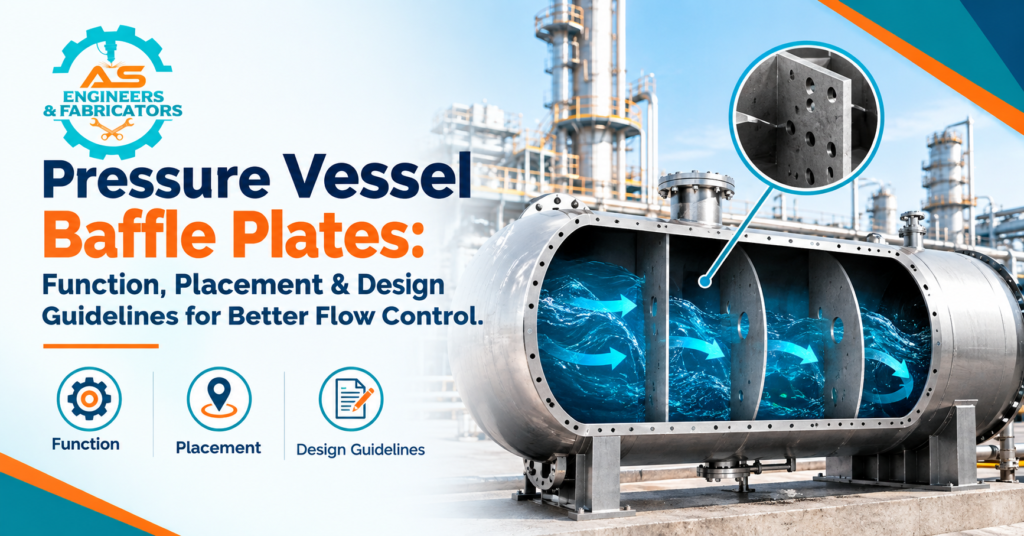
A baffle is generally installed vertically inside a tank to deflect and reduce the overall rotation of fluid flow.
An anti-vortex plate, on the other hand, is installed near the outlet nozzle of a tank or vessel to stop localized vortex formation.
While baffles are more common, both baffles and anti-vortex plates can be used together in tanks where high flow rates or agitation cause excessive fluid rotation. Integrated tank solutions from Asefs India often include both components where required.
Conclusion
In conclusion, an anti-vortex plate works by disrupting the rotational flow pattern that causes vortex formation during liquid discharge. Forcing the flow to become more evenly distributed around the outlet nozzle, it prevents air entrainment and protects downstream equipment from damage.
Anti-vortex plates are a simple and cost-effective way to improve system reliability in storage tanks, process vessels, pump suction lines, and separator systems where uncontrolled vortexing can occur. High-quality engineered plates from Asefs India are designed to deliver long-term operational stability.
Also Read:- Types of Galvanized Gratings and Their Applications in Construction
Frequently Asked Questions
- When is an anti-vortex plate required?
Ans: An anti-vortex plate is required whenever liquid discharge through an outlet nozzle creates the potential for vortex formation, especially in pump suction lines or when operating at low tank levels.
- Does an anti-vortex plate restrict flow?
Ans: When properly sized, an anti-vortex plate does not significantly restrict flow. It simply alters the flow pattern to prevent vortices.
- Can an anti-vortex plate be retrofitted in existing tanks?
Ans: Yes, anti-vortex plates can typically be welded or bolted in place in existing tanks.
- Is an anti-vortex plate necessary for all tanks?
Ans: No, not all tanks require anti-vortex plates. It is mainly needed in tanks with high discharge rates or where air entrainment must be avoided.
- How do you size an anti-vortex plate?
Ans: Sizing an anti-vortex plate depends on the outlet diameter, flow rate, and fluid properties. Engineering calculations or CFD analysis should be done for critical applications.