
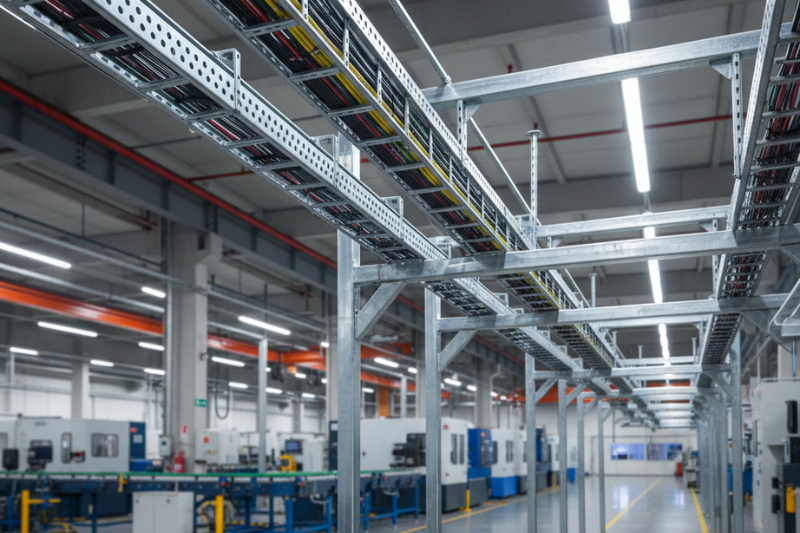
A modern industrial or commercial project needs an effective cabling management system. A power plant, refinery, manufacturing unit, data center, or commercial building – all these complex facilities require organized routing of electrical wires, power cables, and communication lines for safety, performance, and durability. With multiple cable management systems in use today, perforated type cable trays have become one of the most commonly adopted and trusted solutions across industries.
Perforated type cable trays are manufactured by ASEFS India to comply with industry standards for strength, durability, and versatility to suit different installation environments. This blog will explain perforated type cable trays, their benefits, applications, installation process, and common FAQs.
A perforated type cable tray is a metal cable support system with holes or perforations running uniformly across the base and side rails. These perforations provide ventilation, drainage, and an easy cable fixing mechanism for both power and control cables.
Perforated type cable trays are designed and manufactured by ASEFS India for indoor, outdoor, and heavy-duty industrial environments without compromising on safety and load-carrying standards.
Also Read:- Lifting Brackets for Scaffolding: Types, Safety & Applications
Constant air flow around the cables helps dissipate heat. Ventilation is required for power cables that carry higher currents and can get heated. Limited ventilation may cause high temperatures, thereby affecting the life and performance of cables.
Incorrect cable routing can lead to.
Keeping the cables neat, accessible, and fixed through perforations makes it easy to inspect and work on the cables.
Made from heavy-duty steel sections with uniform construction, perforated type cable trays by asefsindia.com are engineered to support higher cable loads without sagging, bending, or permanent deformation. It can also be used in industrial projects where cables run longer distances.
The perforated tray design is highly flexible. The addition of more cables or changing the routing does not require dismantling of the entire tray. Clamps, ties, or cable separators can be fixed through perforations.
Perforated trays can be used for chemical plants, coastal areas, or other environments with high humidity.
Perforated type cable trays are used in most industries for their versatility and strength.
Power cables, control cables, and instrumentation wiring in thermal, hydro, and renewable power projects are commonly supported using perforated trays. Ventilation also helps in the heat management of high-voltage cables.
Oil refineries and petrochemical plants require cable trays that can withstand extreme conditions. Mechanical strength and chemical resistance of perforated trays (with suitable coating) help in safe routing across process plants.
Factories and industrial plants have complex electrical systems that need proper routing along production lines, control rooms, utility corridors, and other areas. Perforated cable trays are supplied as per the plant layout and load requirement.
Airports, malls, hospitals, and commercial complexes are large infrastructure projects that have dedicated space for power wiring, fire alarm cables, and communication cables. All these are supported by perforated trays. The neat and clean appearance also helps in facility management.
Ventilation, no cable congestion, and easy identification for maintenance are some key factors for data centers and IT facilities. Perforated trays are ideal for data centers for effective cable management.
Installation of the cable tray system should follow an optimum approach for safety and durability. The following is the commonly used approach for the installation of perforated trays in industrial projects.
Installation engineers assess the project.
So that a suitable tray width, thickness, and material can be selected.
Wall brackets, floor stands, or overhead hangers are fixed at the desired spacing. Adequate support spacing ensures there is no deflection of trays under load.
Perforated trays are placed on the supports and made to align. Keeping it level and straight will ensure uniform load distribution.
Couplers, splice plates, bends, tees, and reducers are fitted between tray sections, and other accessories are fixed wherever needed. All joints and fasteners are tightened properly.
Cables are laid in an organized manner and fixed with clamps or ties on the tray using perforations. It will prevent any movement of cables and also mechanical damage.
Complete inspection of the installed system for load compliance, proper fixing, clearance, and accessibility is conducted. ASEFS India follows installation guidelines for industrial and safety standards.
ASEFS India is a reputed industrial fabrication shop and cable management solution provider.
The company caters to power, oil & gas, infrastructure, chemical, and manufacturing sectors across India and exports to international markets.
Maintenance is almost negligible in perforated type cable trays.
However, periodic inspection can improve the service life of the system:
Regular inspection helps ensure uninterrupted operation and safety.
Also Read:- Top Dish End Manufacturers in India: Quality, Standards & Pricing
An appropriately designed and installed perforated type cable tray system is a vital component of safe, neat, and effective cable management for all modern industrial projects. The strength, ventilation, flexibility, and durability of this tray type have made it the preferred choice for many applications and projects in various industries.
ASEFS India is an industry veteran in fabrication and industrial solutions, and it delivers high-quality perforated type cable trays that cater to industry requirements and performance expectations.
Ans: The perforated tray offers high load-carrying capacity along with excellent ventilation. That is the primary advantage and reason for the extensive use of both power and control cables.
Ans: Yes. Perforated trays with hot-dip galvanized or other suitable coatings are good for outdoor and corrosive environments.
Ans: The perforated type tray has better support for small or control cables, while the ladder type tray is good for heavy power cables that require maximum ventilation.
Ans: Yes. Customers can get trays as per desired width, thickness, surface finish, and other accessories as per their project requirements.
Ans: Power plants, oil & gas facilities, manufacturing, data centers, infrastructure projects, and commercial buildings are some common industries that use perforated type cable trays.














I help Engineering Importers achieve Rapid Growth and make a Positive Market Impact. I help Client achieve their Business Goals
+91 92267 69978
+91 89569 38780
info@asefsindia.com
2025 © A.S Engineers - All rights reserved