
Manufacturers from diverse industries across the world, such as oil and gas, petrochemical, food processing, pharmaceutical, boilers and pressure vessels, storage tanks, LPG storage, heat exchangers, and many fabrication applications, depend on quality disc ends, end caps, or tank heads for various high-pressure and industrial needs. ASEFS India is among the leading dish-end manufacturers in India that has built a comprehensive and quality-oriented system for meeting all technical, dimensional, and international regulatory standards for each end cap and dish head procured by businesses.
The following article provides a step-by-step process of manufacturing dish ends at ASEFS India to help organizations that are exploring dish end manufacturing services get a basic idea of the company’s capability, expertise, precision manufacturing practices, and custom engineering services for different projects.
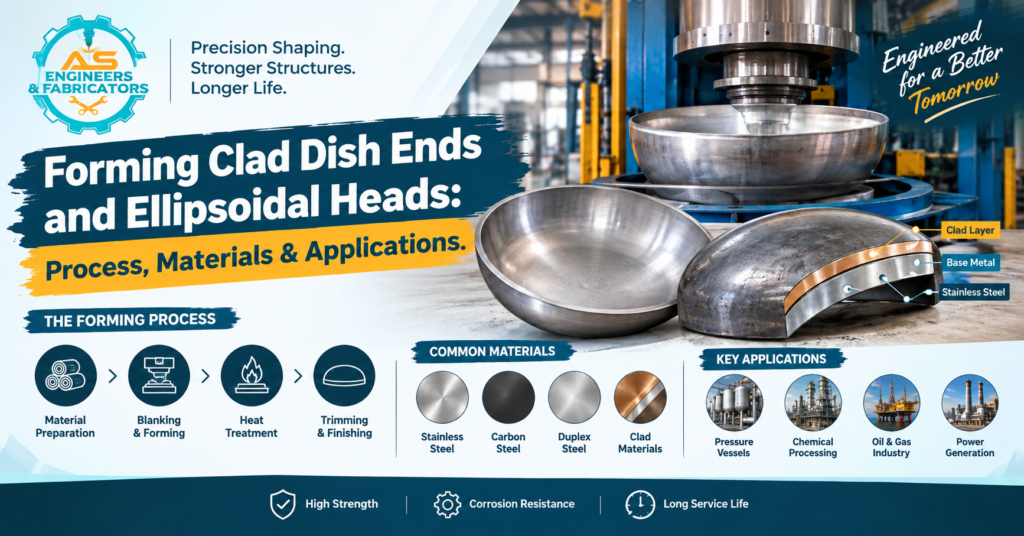
The first step in the manufacturing of dish ends involves the selection of raw material that is suitable for the intended application. As a matter of fact, disc ends can be manufactured using different metal grades such as carbon steel, stainless steel, alloy steel, duplex steel, and custom metal materials that are defined by the project specifications.
Since dish ends are typically used in high-pressure, high-temperature, and highly corrosive industrial environments, material selection must meet the national and international standards.
Material qualification is an essential requirement for all pressure vessel disc ends, boiler disc ends, torispherical dish ends, ellipsoidal dish ends, and so on. ASEFS India will only approve every sheet or plate before it is allowed to move to the next phase of forming.
Subsequently, the approved plate will be cut to the specified diameter for the dish end. ASEFS India can use various modern plate cutting techniques, including CNC plate cutting, plasma cutting, oxy-fuel cutting, and laser cutting (when necessary), to prepare plates for forming. These methods offer benefits such as smooth edges, accurate dimensions, and low material wastage. Additionally, since precision is highly crucial for manufacturing industrial dish ends and fabricated tank heads, ASEFS India ensures the pre-forming preparation stage is executed with high-dimensional accuracy.
Edge preparation is also done for welding-based dish ends to make sure that joints are strong and the surface condition is uniform.
Most of the manufacturing processes for dish ends will also require controlled heating to help improve the metal’s malleability. ASEFS India uses standardized heating techniques that guarantee the uniform distribution of temperature all over the plate. This stage will help reduce material stress while increasing its formability.
The right heating allows the metal surface to attain the necessary ductility, especially when manufacturing thick-plate dish ends, large-diameter dish ends, heavy-duty pressure vessel dish ends, and other high-performance types.
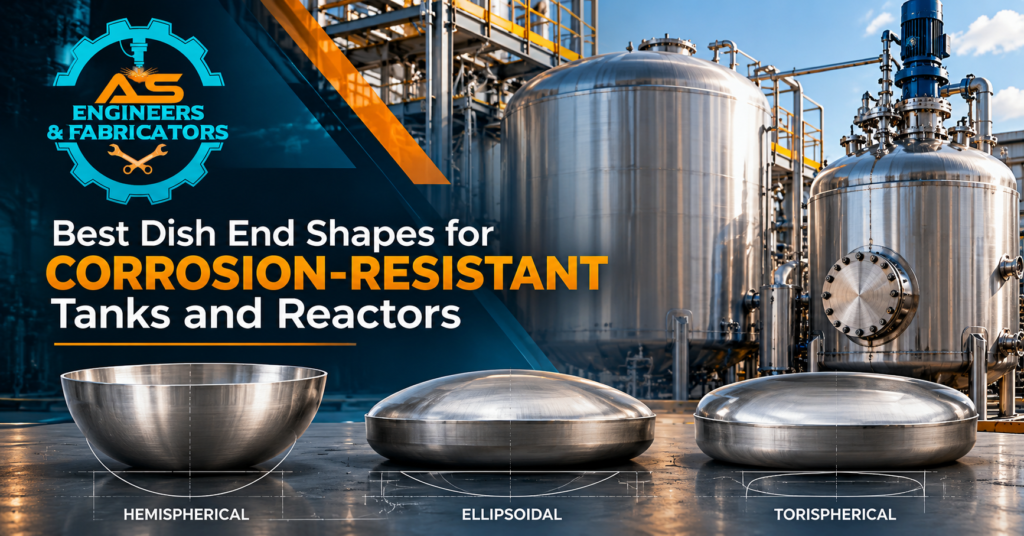
Also Read:-Hemispherical vs Ellipsoidal vs Torispherical Dish Ends: Which One Fits Your
The forming stage is the heart of the dish end manufacturing process. ASEFS India can use several forming technologies depending on the design needs and material requirements.
Spinning is suitable for producing smooth and dimensionally precise ellipsoidal dish ends, torispherical dish ends, and hemispherical disc ends. In this method, the plate is spun at a very high speed, and then pressure is gradually applied to it to form it into the required profile. ASEFS India’s CNC spinning machines make sure that the tolerances are within limits and repeatability is guaranteed.
Hydraulic pressing is another practical method of manufacturing dish ends, especially for larger dish ends or thicker plates. ASEFS India has high-capacity hydraulic presses that can generate sufficient pressure on the plate uniformly. Boiler dish ends, storage tank caps, LPG and CNG vessel dish ends, and custom-shaped industrial dish ends can be produced using this method. The pressing operation will also make sure that the thickness is distributed uniformly for structural integrity.
Dishing refers to the process of forming the dome shape of the dish end using a dishing press. In the same way, flanging involves forming the skirt or straight flange of the disc end. ASEFS India uses state-of-the-art flanging machines that produce flanges with the right curvature without cracks, wrinkles, or distortions.
Some dish ends might also require welding, especially if they are being manufactured from more than one component or with the segmental forming method.
The company will make sure that all welding operations are in compliance with ASME, IS, and all applicable standards.
The quality of welding will play a vital role in determining the performance of pressure-rated dish ends that are to be used in boilers, chemical reactors, and high-pressure vessels.
Heat treatment after forming is also necessary for relieving any residual stress in the disc end. This process will also help restore the mechanical strength of the material.
Heat treatment will guarantee that the finished disc ends will meet the desired mechanical strength and deliver safe and long-term performance for industrial uses.
Also Read:-MSRL Tanks and Piping Spools: Corrosion-Resistant Solutions for Chemical Plants
Heat treatment after forming is also necessary for relieving any residual stress in the disc end. This process will also help restore the mechanical strength of the material.
Heat treatment will guarantee that the finished disc ends will meet the desired mechanical strength and deliver safe and long-term performance for industrial uses.
Before dispatch, a multi-level inspection will be done on every disc end.
The main aim is to guarantee that the final product will adhere to ASME, DIN, IS, EN, and customer-specified codes.
Disc ends that have passed the final inspection will then be marked with all the necessary information, such as the material grade, heat number, batch number, size, manufacturing specifications, and more. ASEFS India uses export-grade packing procedures that include wooden packing, steel palletization, and protective wrapping to prevent damage during transit.
ASEFS India is a well-known company for its high-precision manufacturing, diverse material capability, advanced machinery for spinning, pressing, and flanging, and strict quality control. The company also complies with international standards, offers custom engineering solutions, and delivers timely and reliable service support. Whether clients need ellipsoidal disc ends, torispherical heads, hemispherical disc ends, or custom-fabricated tank heads, ASEFS India can deliver quality, consistency, and long-term performance.
Ans: ASEFS India is a manufacturer of a complete range of ellipsoidal dish ends, torispherical dish ends, hemispherical dish ends, pressure vessel dish ends, boiler disc ends, stainless steel dish ends, carbon steel dish ends, and custom-fabricated industrial dish ends for diverse sectors.
Ans: Dish ends from ASEFS India comply with ASME, DIN, IS, EN, PED, and international pressure vessel standards, which means they are suitable for high-pressure and industrial applications.
Ans: Yes. ASEFS India specializes in the production of large-diameter dish ends, heavy-wall dish ends, and high-pressure vessel disc ends using advanced hydraulic pressing, spinning, and flanging technologies.
Ans: ASEFS India manufactures dish ends from stainless steel, carbon steel, alloy steel, duplex steel, and custom special-grade metals to ensure compatibility with diverse industrial applications such as oil and gas, chemical, and food processing.
Ans: Yes. ASEFS India offers custom dish end manufacturing services with dimensions, thicknesses, material grades, finishing options, and testing requirements that are tailored to client specifications.



I help Engineering Importers achieve Rapid Growth and make a Positive Market Impact. I help Client achieve their Business Goals
+91 92267 69978
+91 89569 38780
info@asefsindia.com
2025 © A.S Engineers - All rights reserved