
When you’re working with high-pressure vessels, every component matters. The end closures (commonly called dish ends or dished heads) are some of the most critical pressure vessel components you’ll spec. They’re not just caps. They’re engineered structures that distribute stress, contain extreme pressures, and keep operations safe.
Modern manufacturing techniques have changed how we think about dish end design. Advanced forming methods, precision CNC controls, and hydroforming technologies create what some in the industry call “gliding” fabrication processes. These smooth, controlled forming techniques produce dish ends with better surface quality, tighter tolerances, and superior pressure resistance.
Let’s break down what you need to know about these critical components, how they’re made, and why they matter for your next project.
Pressure vessels need end closures that can handle internal forces without failing. Flat ends might seem simpler, but they create a 90-degree stress concentration where they meet the cylindrical shell. This sudden angle creates weak points that can lead to catastrophic failure under pressure.
Dished ends solve this problem through geometry. Their curved shape distributes stress more evenly across the surface, eliminating sharp transitions. Think of it like an arch in architecture. The curved form naturally channels forces in a way that flat structures simply can’t match.
Here’s why the shape matters:
A flat end under the same pressure conditions would need to be 3 to 5 times thicker than a properly designed dish end. For a vessel requiring a 10mm hemispherical head, you’d need a flat end between 30mm and 50mm thick. That’s a massive difference in material cost, weight, and welding complexity.
The curved geometry also increases internal volume compared to flat closures. For storage and processing applications, this means better capacity utilization without increasing the vessel’s footprint.
Also Read:-Applications of Rubber Lined Pipe Spools in Process Industries
Different applications call for different dish end configurations. Each type offers specific advantages in strength, manufacturing cost, and pressure resistance.
These half-sphere shapes deliver the best pressure resistance of any dish end type. The perfectly rounded geometry distributes stress uniformly across the entire surface, making them ideal for extreme high-pressure applications.
For the same design pressure and diameter, a hemispherical head needs roughly half the wall thickness of the cylindrical shell it’s attached to. If your vessel shell is 12mm thick, the hemispherical end might only need 6mm.
The tradeoff? They’re the most expensive to manufacture. The deep draw requires multiple forming operations, and larger diameters often need segmented construction with multiple welds. But when you’re working with truly high pressures, nothing beats the strength-to-weight ratio.
The 2:1 ellipsoidal head (where the major axis is twice the minor axis) hits a sweet spot between performance and cost. These pressure vessel components deliver excellent stress distribution with less depth than hemispherical designs.
For the same design conditions, an ellipsoidal dish end typically requires wall thickness approximately equal to the shell thickness. This makes design calculations straightforward and fabrication more economical than hemispheres.
They’re particularly popular in medium to high-pressure vessels where space is a consideration. The shallower profile means less overall vessel length while still providing strong pressure containment.
Also known as flanged and dished heads, these are the most cost-effective option for moderate pressure applications. The design combines a spherical crown with a toroidal knuckle radius, creating a flatter profile that’s easier to form.
The knuckle radius (where the dish transitions to the straight flange) is the critical design element. For ASME-compliant heads, this radius must be at least 6% of the outside diameter. This knuckle creates a stress concentration point that designers must account for.
For the same design pressure, a torispherical head needs wall thickness about 1.77 times the shell thickness. They’re widely used in storage tanks, moderate-pressure vessels, and applications where the slightly higher wall thickness is offset by easier and faster manufacturing.
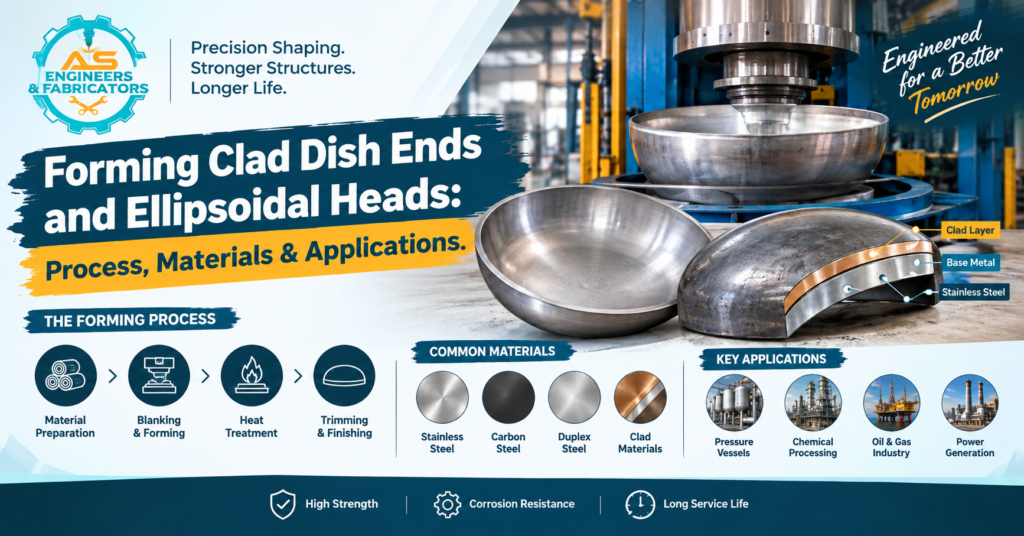
Advanced forming technologies have transformed dish end production. What manufacturers sometimes refer to as “gliding” processes involves smooth, controlled metal forming that produces superior results.
Hydroforming represents a major advancement in dish end manufacturing. Instead of steel dies hammering the material into shape, high-pressure water (often 5,000 to 20,000 psi) presses the blank against a forming die.
The advantages are clear:
Production speed increases dramatically. A dish end that might take hours using traditional methods can be formed in minutes. The water pressure creates uniform force across the entire surface, resulting in consistent thickness and minimal thinning. Surface finish quality is exceptional because there’s no metal-on-metal contact leaving tool marks.
The process also offers flexibility. By changing the die, you can form elliptical, circular, oval, and complex polycentric shapes on the same equipment.
Modern dishing presses use computer numerical control to manage every aspect of the forming process. Multiple hits across the workpiece gradually shape the material while sophisticated sensors monitor thickness, depth, and dimensional accuracy in real time.
The latest flanging equipment employs friction-free technology with ball rails and ball screws. This allows smooth, precise movement even under high clamping forces. The result? Better dimensional control and less material waste.
Pressure control systems prevent plate squeezing during flanging operations. This is critical for high-pressure vessels where even slight thickness variations can compromise safety. With proper CNC gap control, even less experienced operators can achieve consistent results.
Both methods have their place, but hot pressing generally produces superior quality for high-pressure applications. Heating the material before forming reduces work hardening and allows for tighter radii without cracking.
Cold-formed heads often look shinier and more finished straight off the press. But hot-pressed heads, while initially rougher, can be finished to the same appearance through shot blasting and coating. More importantly, the metallurgical properties of hot-pressed components better suit demanding high-pressure service.
The right material makes all the difference in vessel performance and longevity. Selection depends on operating pressure, temperature, corrosion resistance requirements, and regulatory compliance.
Carbon steel remains the workhorse material for many pressure vessel applications. Grades like A516-70 are widely used in petroleum, power generation, and chemical processing. This steel maintains strength up to 340°C and remains ductile down to -45°C.
For higher strength applications, Q345B and similar alloys provide better yield strength while maintaining good weldability and toughness.
Stainless steel dish ends resist corrosion in demanding chemical and pharmaceutical applications. Common grades include:
304 and 304L for general corrosion resistance 316 and 316L for chloride environments and marine applications 321 for high-temperature service with better creep resistance
The “L” designations indicate lower carbon content, which improves weldability and reduces sensitization in heat-affected zones.
Extreme conditions call for specialized materials. Duplex steels combine austenitic and ferritic structures for superior strength and corrosion resistance. Titanium offers exceptional corrosion resistance at lighter weight. Nickel alloys like Hastelloy handle highly corrosive chemicals at elevated temperatures.
Companies like ASEFS India work with the full range of materials to match each application’s specific requirements, from standard carbon steel to exotic alloys.
High-pressure vessels demand rigorous testing throughout fabrication. Multiple inspection methods verify that dish ends meet design specifications and code requirements.
Surface defects are detected through visual inspection, magnetic particle testing, and liquid penetrant inspection. Subsurface flaws require ultrasonic testing or radiographic examination.
Modern UT equipment can map the entire dish end, creating a thickness profile that identifies any thin areas or laminations. This is particularly important for hot-pressed heads where the forming process must be carefully controlled.
After fabrication and welding, complete vessels undergo hydrostatic testing. The vessel is filled with water and pressurized to 1.3 to 1.5 times the maximum allowable working pressure. This confirms structural integrity and reveals any leaks.
Pneumatic testing uses compressed air or inert gas instead of water. This is more dangerous due to the stored energy in compressed gas, so it requires additional safety protocols and is typically used only when hydrostatic testing isn’t practical.
Every dish end must meet dimensional tolerances for diameter, depth, knuckle radius, crown radius, and thickness. Advanced measurement systems using laser scanning can verify these parameters quickly and accurately.
Tolerances are tight for high-pressure applications. A knuckle radius that’s too small creates excessive stress concentration. A crown radius that’s too large changes the strength calculations. Proper verification ensures the as-built component matches the engineering design.
High-pressure dish ends serve countless industries where safe containment of pressurized materials is essential.
Refineries, gas processing plants, and petrochemical facilities rely on pressure vessels with properly designed dish ends. These vessels handle flammable and hazardous materials at pressures that can exceed 3,000 psi. Separator vessels, reactors, and distillation columns all require robust end closures.
Boilers, heat recovery steam generators, and feedwater heaters in power plants operate at extreme pressures and temperatures. The dish ends must withstand thermal cycling and maintain integrity over decades of operation.
Process vessels, reactors, and storage tanks in these industries require dish ends that resist corrosion while meeting strict hygiene standards. Stainless steel pressure vessel components are standard, often with specialized surface finishes to prevent contamination.
Reverse osmosis systems, pressure filtration vessels, and treatment tanks all use dished ends. Municipal and industrial water treatment facilities depend on these components for reliable long-term service.
When you need quality pressure vessel components, working with experienced fabricators makes the difference. ASEFS India brings deep expertise in designing and manufacturing pressure vessels and related equipment for diverse industrial applications.
Their capabilities span the complete range of vessel types, from simple storage tanks to complex ASME-certified pressure vessels. They understand that each project has unique requirements for materials, dimensions, testing, and compliance.
Whether you’re sourcing components for a new facility or replacing equipment in an existing plant, ASEFS India can provide technical guidance on material selection, design optimization, and regulatory compliance. Their experience across multiple industries means they understand the real-world challenges you face.
Getting the dish ends right requires careful attention to several factors. Here’s what to consider when specifying these critical components.
Know your maximum allowable working pressure and design pressure (typically MAWP plus a safety margin). Temperature affects material properties, so specify both operating and design temperatures. Some materials lose strength at elevated temperatures, while others become brittle when cold.
Add extra thickness to account for corrosion over the vessel’s design life. A typical allowance might be 1-3mm depending on the environment and expected service life. This ensures the vessel maintains required strength even as the surface corrodes.
Most pressure vessels must meet ASME Section VIII Division 1 or Division 2 requirements. Some applications require additional certifications like National Board registration, PESO approval, or IBR compliance. Make sure your fabricator has the necessary certifications and stamps.
Penetrations through dish ends require careful reinforcement calculations. The openings reduce the pressure-bearing area, so you need to add material around the nozzle or use a thicker head. Attachment points for internal components also create local stress concentrations that must be analyzed.
Extremely large diameter dish ends may need segmented construction because forming equipment has size limits. Very thick materials are harder to form and may require hot working. Your design should account for these practical manufacturing considerations.
The pressure vessel industry continues to evolve, driven by demands for higher performance, better safety, and lower costs.
Advanced materials research is producing alloys with better strength-to-weight ratios and improved corrosion resistance. Composite materials are being explored for some applications, though metallic vessels still dominate high-pressure use.
Additive manufacturing (3D printing) shows promise for complex geometries and repair applications. While unlikely to replace traditional forming for large dish ends soon, it could enable optimized designs that are difficult or impossible to fabricate conventionally.
Simulation software continues to improve, allowing engineers to optimize dish end designs before fabrication begins. Finite element analysis can predict stress distributions, thermal behavior, and fatigue life with increasing accuracy.
Also Read:-Why Tundish Quality Matters in Continuous Casting Operations
What is the difference between gliding dish ends and standard dish ends?
The term “gliding” generally refers to advanced manufacturing processes that use smooth, controlled forming rather than traditional hammering or stamping. Hydroforming and precision CNC dishing presses create dish ends with superior surface finish, tighter dimensional tolerances, and more consistent material properties. The end product is a dish end with better pressure resistance and longer service life compared to older manufacturing methods.
How do I choose between ellipsoidal and torispherical dish ends for my pressure vessel?
Your choice depends on operating pressure and budget. Ellipsoidal dish ends handle higher pressures with wall thickness roughly equal to your shell thickness, making them ideal for medium to high-pressure applications. Torispherical heads cost less to manufacture but need thicker walls (about 1.77 times shell thickness) for the same pressure rating. For pressures above 300 psi, ellipsoidal heads usually make more economic sense.
What are the most common failure points in pressure vessel dish ends?
The knuckle radius area in torispherical heads experiences the highest stress concentration and is most prone to failure if improperly designed or manufactured. Weld joints between the dish end and shell are also critical areas. Corrosion thinning can compromise any dish end over time if proper corrosion allowance wasn’t included in the original design. Regular inspection and thickness monitoring prevent unexpected failures.
Can dish ends be repaired or do they need replacement when damaged?
Minor surface corrosion and small defects can often be repaired through grinding and weld buildup, followed by heat treatment and retesting. Cracks, severe corrosion, or bulging typically require replacement because the structural integrity has been compromised. Any repair must be done according to applicable code requirements and approved by an authorized inspector before returning the vessel to service.
What certifications should I look for when sourcing high-pressure vessel components?
For international compliance, look for ASME U-stamp certification, which indicates the fabricator meets ASME Boiler and Pressure Vessel Code requirements. Additional certifications include National Board NB-stamp for repairs and alterations, ISO 9001 for quality management, and specific approvals like PESO (India), IBR (Indian Boiler Regulations), or PED (European Pressure Equipment Directive) depending on where the vessel will operate.




At A.S. Engineers & Fabricators, our team excels in designing, manufacturing, and erecting steel structures that set industry benchmarks. We have established a robust presence in metal fabrication, heavy equipment, and steel structures, providing top-tier solutions for industrial plants and high-rise buildings.
+91 92267 69978
+91 89569 38780
info@asefsindia.com
2025 © A.S Engineers - All rights reserved