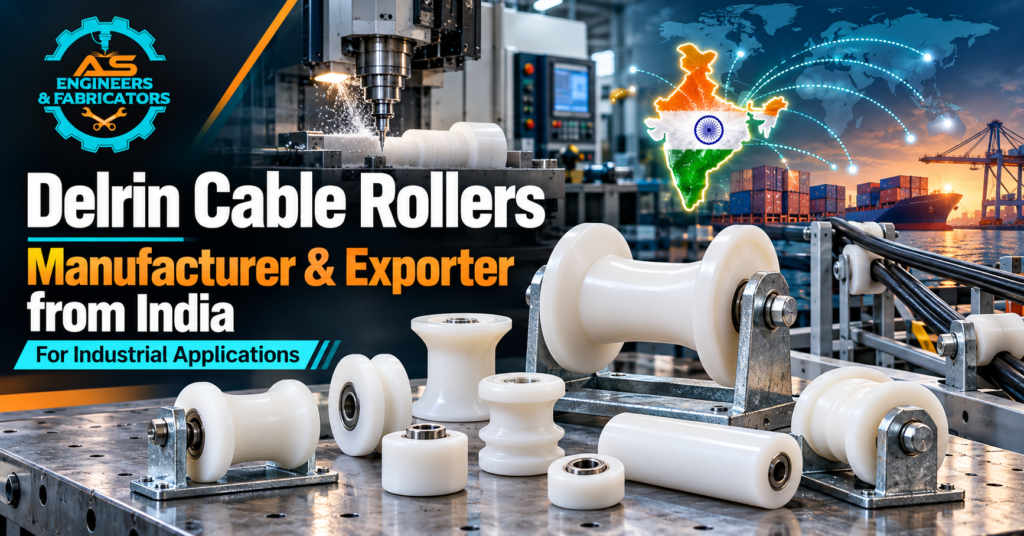
Delrin Cable Rollers Manufacturer & Exporter from India for Industrial Applications
By A.S. Engineers & Fabricators Technical Team | Ambernath MIDC, Maharashtra. It’s not just about the cable pulling force. The route, the support points, and the contact surfaces also influence how a cable runs in an installation or a machine.
A cable roller supports or guides the cable and allows movement of the cable along a predetermined path. For selected applications, the machined Delrin® roller body is worth considering, as the material combines useful mechanical properties with low friction and wear resistance.
Buyers looking for a Delrin cable roller manufacturer & exporter from India should specify cable, operating load, water treatment, roller geometry, pressure vessels and mounting arrangement in the right inquiry. These details are just as important as the choice of plastic.
A.S. “Engineers & Fabricators (ASEFS India), Ambernath MIDC, Maharashtra, publishes precision machining and custom industrial manufacturing capabilities. This guide provides information on how to evaluate Delrin cable rollers and how to prepare a clear specification for manufacturing and export enquiries.
Also Read: How ASEFS India Contributes to Singapore’s Industrial Machinery and Equipment Sector
What Are Cable Rollers Made Out of Delrin?
A Delrin cable roller has a cable-contacting part formed of an acetal homopolymer body. Depending on the design, it may rotate on a bush, bearing, or other specified mounting arrangement.
The entire assembly may further include an axle, fasteners, side plates, and a support frame. The roller material does not determine the capacity of those other parts.
Cable laying equipment is available in many configurations for straight runs, corners, and entry points. For a custom polymer roller, the designer needs to determine the required shape and support arrangement from the actual cable route.
A roller for guiding a cable should also be distinguishable from a driven traction component for gripping and pulling it. Their needs for contact will be different.
Don’t Be Vague About Your Material: Delrin vs. Generic Acetal
Delrin® is a trademark for a type of acetal homopolymer, often called POM-H. Acetal is a more general family of materials that includes copolymers.
The material producer indicates that homopolymer and copolymer acetals have different structures and performance characteristics. Thus, a quote referring only to “acetal” does not establish the brand or grade.
What questions should buyers ask?
Where true Delrin is specified, state the approved grade and request material identification records. Where an alternative is acceptable, specify the polymer type and performance requirements and establish an approval process for substitutions;
Material colour alone is not sufficient evidence of grade.
The purpose is to confirm that the supplied roller is to the approved design basis and not to a general commercial description.
Why Delrin for Industrial Cable Rollers?
Delrin should be evaluated for use with a given roller and operating conditions.
Low Friction and Wear Performance
Low friction and wear resistance are cited in Delrin’s Material Guidance as reasons to consider it for moving components. It also describes that the performance depends on the interacting surfaces and the working environment.
These properties can be used for evaluation of a roller material. They do not by themselves determine the cable pulling force or the service life of the complete assembly.
How well is it machinable?
Delrin is available in stock shapes for machining, and the producer lists rollers as one of its component applications. This makes it a candidate for evaluation of custom profiles and drawing-based replacement parts.
Custom grade selection
The Delrin portfolio contains grades for different performance priorities. Choose the grade based on the load, temperature, wear, and environmental requirements instead of treating all Delrin products as the same.
Industrial Applications to be Assessed
These are some possible contexts of inquiry. Suitability for the roller is to be assessed from design and service conditions.
Application | Cable-handling requirement | Main selection questions |
Industrial cable installation | Support cable along the planned route | What are the cable size, route geometry and support loads? |
Cable manufacturing equipment | Guide the cable between process stages. | What are the speed, alignment and contact requirements? |
Rewinding or inspection stations | Maintain a controlled cable path. | What diameter range and operating tension must be accommodated? |
Machinery cable guides | Direct movement within an assembly | What are the travel, mounting and clearance constraints? |
Maintenance replacements | Replace an existing roller. | Is the original drawing available, and what caused the previous part to wear? |
These examples are a starting point for specification, not a proof that one roller design can fit all applications.
Cable roller profiles and assembly variants
Different profiles address different guidance problems. Select the profile based on the cable path and contact requirements.
Straight rollers
These support a cable on its way. Confirm usable contact width, cable position, and method of mounting.
Grooved Rollers
A groove can provide lateral guidance, but it must be the same shape as the cable. The inquiry should give the diameter range of the cables to be used and the profile of the groove.
Flanged Rollers
Flanges can help maintain the cable on the right path. Check clearances and edge details to ensure that the guidance arrangement does not create an unwanted contact point.
Corner or Multi-Roller Arrangements
A directional change could include multiple rollers instead of one component. The route influences the layout of equipment, so cable-laying manufacturers provide different corner, straight-line, and lead-in configurations.
A custom inquiry should show the desired cable route and not just an isolated roller drawing.
Cable Bend Radius: A Critical Design Input
Choosing a roller isn’t just about cable diameter.
Use the cable manufacturer’s minimum bend-radius requirements. Prysmian’s installation guidance separates installation bending conditions from some static conditions and notes that larger radii may be required for higher pulling tension.
See the entire path.
Observe the cable as it approaches the roller arrangement, makes contact with the rollers, and leaves the rollers. A cable that seats into a groove can still follow a bad bend.
Do not use a single diameter multiplier for all cable types. Get the correct cable specification and check the entire installation or machine layout against it.
The radius of the groove cross-section and the overall bending radius of the cable are different geometric considerations. Both need to be clear in the design.
Load, Speed & Bearing Fit
Specify a Delrin cable roller as part of a mechanical assembly.
Operating loads
State the expected load on the roller considering the weight of the cable, operating tension, and route changes if applicable. Indicate whether the load is continuous, intermittent, or impact loaded.
Find the deformation with time for sustained loading. According to the creep guidance of Delrin, long-term behaviour is influenced by temperature, stress, moisture, and material composition.
Operating Speed
Cable travel speed and expected operating cycles. The designer can then evaluate roller rotation, bearing selection and the service duty required.
Shaft and Bearing Interfaces
Locate the bore, bearing seats, shoulders, retaining details, and shaft layout on the drawing. Fits and measurement conditions as agreed upon.
Together, inspect the roller body, bearing, axle, and mounting frame. A material datasheet cannot ever determine the capacity of the entire cable-handling assembly.
Delrin Parts Manufacturer and Precision Engineer
Delrin cable rollers can be considered as machined parts made from appropriate stock shapes.
The material producer recommends sharp cutting edges, controlled machining heat, and proper clamping. Improper workholding can damage or distort even a stiff engineering plastic.
A practical drawing-based manufacturing workflow is as follows:
Refer to component drawing and service conditions.
Please confirm the material and stock specification
Agree on critical dimensions, tolerances, and inspection requirements.
Specify the machine roller body, bore, and profile.
Finish edges and check components.
Perform any agreed-upon assembly and first article inspection.
For production repeats, retain the approved drawing revision and material designation. Any change to the groove, bearing interface, or grade should be reviewed before the next batch.
Fabrication quality control and dimensional inspection
A useful inspection plan will concentrate on the features that affect cable contact, assembly and rotation.
Checks may include, depending on the drawing:
Outside diameter and contact width.
Groove dimensions and profile.
Bore and bearing-seat dimensions.
Specified runout relative to the bore or assembly datum.
Edge condition and surface finish.
Bearing retention and assembly clearances.
Material identification and component marking.
The inspection method and acceptance criteria should be agreed prior to production. First-article approval can be used to establish a reference for future batches in the case where the part is new or a design is being changed.
Dimensional verification, surface checks, and final inspection are quality activities described in ASEFS India’s machining information. Verify the records required for the specific order.
Why Choose Delrin Over Other Roller Materials
The choice of materials should be driven by the application, not by a claim that one option is always best.
Different contact behaviour can be provided by a rigid machined polymer, a metal roller and an elastomer covered roller. The design team should determine whether the application is based on dimensional control, compliance, traction, wear performance or any other requirement.
Indicate the reason for the proposed material change for an existing installation. Is the problem surface damage, poor guidance, bearing failure, incorrect loading, or some other assembly problem?
Changing the roller material will not necessarily solve a routing or mounting problem. If possible, compare candidate designs in a controlled trial using the intended cable and operating conditions.
Maintenance and Replacement Planning
Low friction material does not make an assembly entirely maintenance-free.
Determine inspection intervals based on the operating duty and the requirements of the equipment manufacturer. Check cable contact surface, groove condition, bearing movement, shaft security, and alignment.
Remove trapped debris. Check for any rough rotation or cable marking. Follow the maintenance instructions given for bearings and other metal parts.
Keep a record of the part number, drawing revision, and material for repeat replacements. If you are experiencing wear prematurely, record the location and operating conditions before ordering the same design again.
Choosing a Delrin Cable Roller Manufacturer in India
The supplier assessment should determine if the manufacturer can manufacture and inspect the required component.
Drawing Critique
Ask the manufacturer to clarify vague dimensions, hard-to-duplicate features, or proposed changes before taking the order.
Traceability of Material
Please confirm if a branded Delrin is required or if an approved acetal alternative is acceptable. Approve existing material records.
Supply of Component or Assembly
Indicate whether the requirement is for roller bodies only or for complete units of bearings, axles and frames.
Inspection and Replenishment
Define critical characteristics, sample approval, and documentation requirements with each lot. Compare quotations for identical supply and inspection scope.
A clear technical agreement is more useful than a general promise of “heavy-duty” performance without a stated design basis.
International Industrial Buyers Export Enquiries
ASEFS India has an international engineering and fabrication export offering.
Agree on the product specification and delivery arrangements together for a bespoke roller order. Confirm the quantity, destination, delivery terms, packaging, and any inspection documents required.
Ask that roller bodies and assemblies be packaged to protect finished surfaces and components during the intended journey. Determine packages and separate portions in which there are several sizes available.
The minimum order quantity, lead time, freight cost, and documentation are subject to the actual inquiry. Please verify this information before scheduling installation or maintenance around the shipment.
ASEFS India Industrial Manufacturing & Precision Machining Solutions
A.S. Engineers & Fabricators lists custom precision machining and engineering capabilities, including work on industrial rollers, guides, and machinery components.
Please share drawings and service details for a component-specific assessment of the requirement for a Delrin cable roller. Check the exact material, profile, load requirements, supply scope, and inspection arrangements prior to ordering.
This approach links the manufacturing inquiry to the actual machine or cable handling task, rather than assuming a non-specific roller is appropriate.
Ask for a quote on custom Delrin cable rollers.
Here is the text you gave me. I have made it more human.
Dimensioned drawing, part number and revision.
Quantity and required delivery schedule.
Cable type, diameter range and relevant installation requirements.
Roller dimensions, groove profile and bearing details.
Operating load, speed, duty cycle and environment.
Required material brand, grade and substitution policy.
Critical tolerances, surface finish and inspection records.
Roller-only or complete-assembly scope.
Delivery destination and packaging requirements.
A.S. Engineers & Fabricators (ASEFS India)
Address: Plot No. W-108/1, Anand Nagar, Additional MIDC, Ambernath East, Thane – 421506, Maharashtra, India.
Phone: +91 92267 69978
Email: info@asefsindia.com
Website: asefsindia.com
Also Read: ASEFS India and Russia’s Industrial Machinery Sector: Solutions, Expertise and Opportunities
Conclusion
A.S. Engineers & Fabricators Delrin is a material to consider for some industrial cable rollers where a custom-machined profile and good wear behaviour are key factors.
Successful selection is dependent on the complete design: cable requirements, groove geometry, load, speed, dish ends, bearings, rubber-lined tank and mounting. Buyers of Delrin cable rollers from a manufacturer & exporter in India should specify these inputs and agree on material and inspection requirements before production.
For ASEFS India enquiries, please submit the drawings and operating conditions to confirm the proposed manufacturing and export scope.
Questions & Answers
1. What is a Delrin cable reel?
Ans: It supports or guides a cable in an installation or in a machine arrangement. Suitability is dependent on the roller design, cable requirements, and operating conditions.
2. Are all acetal cable rollers made of Delrin?
Ans: No, Delrin is the trade name for acetal homopolymer; a generic acetal specification does not name the brand or grade.
3. Can you machine Delrin cable rollers to a drawing?
Ans: Yes. Machinable rollers can be made from Delrin stock shapes. The manufacturer should check the profile, tolerances, material, and quantity before confirming the order.
4. How do you choose the roller size?
Ans: Take into account the cable diameter, allowable bending conditions, working load, speed, groove requirements, and mounting arrangement. The cable diameter is not enough.
5. Yes. Delrin cable rollers are maintenance-free.
Ans: No, not by default. Bearings, shafts, alignment, and contact surfaces still require maintenance as specified for the assembly.
Recent Posts
-
Delrin Cable Rollers Manufacturer & Exporter from India for Industrial Applications
-
 How to Import Industrial Products from India – Step-by-Step Guide
-
 Delrin Parts Manufacturer & Exporter from India for Drones and Robotics
-
 Best Dish End Shapes for Corrosion-Resistant Tanks and Reactors
-
 Propane Storage Tank Manufacturing: Standards, Safety Features & Buying Guide
-
 Pressure Vessel Baffle Plates: Function, Placement & Design Guidelines for Better Flow Control
-
 Why Delrin (Acetal) Machine Parts Outperform Metal Components in Wear Applications
-
 Delrin Sprocket Gears vs Delrin Spur Gears: Which One Fits Your Machine Design?
-
 Forming Clad Dish Ends and Ellipsoidal Heads: Process, Materials & Applications
-
 ASEFS India and Russia’s Industrial Machinery Sector: Solutions, Expertise and Opportunities
-
 How ASEFS India Contributes to Singapore’s Industrial Machinery and Equipment Sector
-
 Construction Indonesia 2026: Connecting Global Construction and Engineering Companies with Indonesia’s Infrastructure Market
-
 AUTOMEX Penang 2026: Connecting Global Automation Companies with Malaysia’s Smart Manufacturing Industry
-
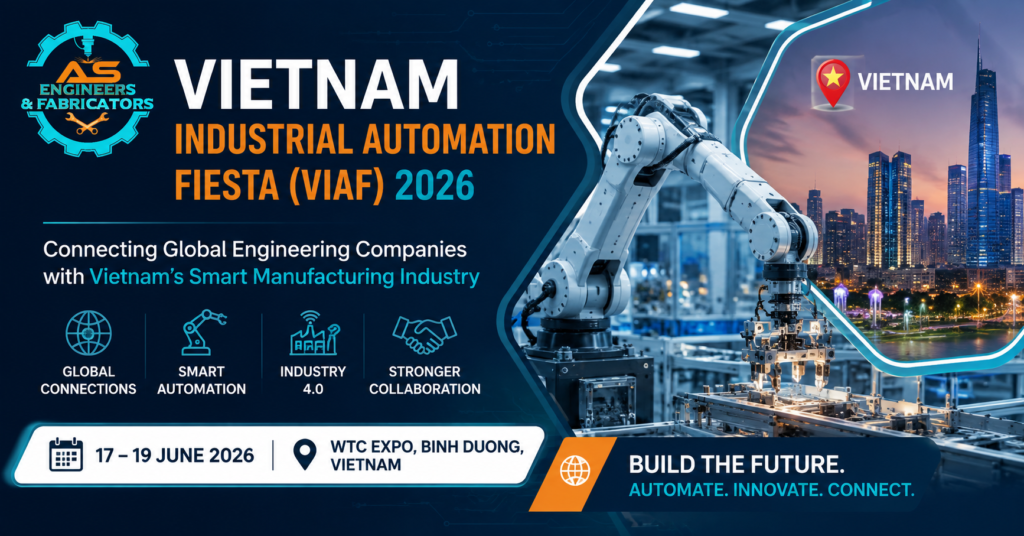 Vietnam Industrial Automation Fiesta (VIAF) 2026: Connecting Global Engineering Companies with Vietnam’s Smart Manufacturing Industry
-
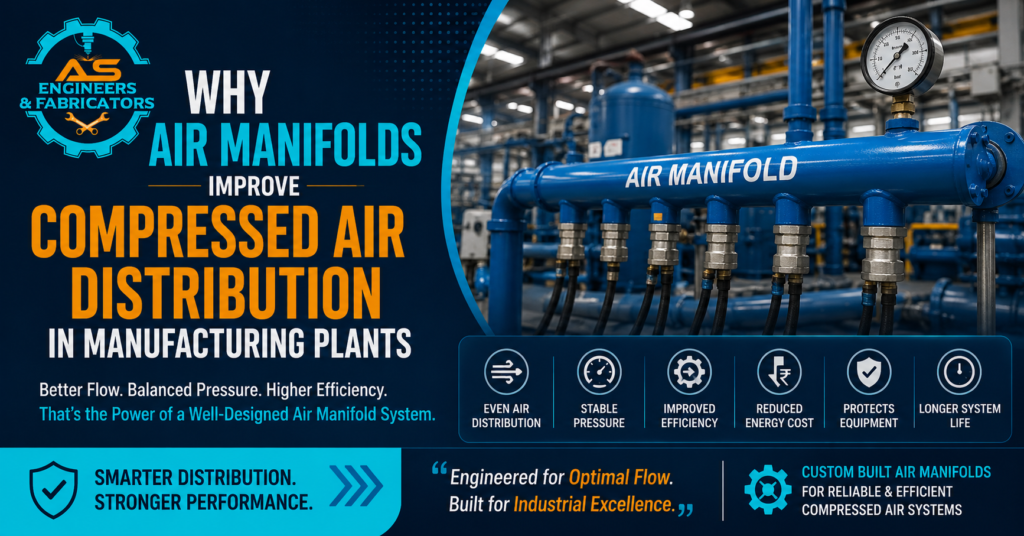 Why Air Manifolds Improve Compressed Air Distribution in Manufacturing Plants

I help Engineering Importers achieve Rapid Growth and make a Positive Market Impact. I help Client achieve their Business Goals