Temperature control can make or break a chemical reaction. Too hot, and you risk runaway reactions. Too cold, and the process grinds to a halt. For decades, chemical and pharmaceutical manufacturers have relied on jacketed vessels, but a growing number are switching to limpet coil tanks for one simple reason: better heat transfer at a lower cost.
If you’re involved in process engineering, production planning, or facility management, understanding how limpet coil tanks work and why they matter could directly impact your bottom line. Let’s break down what makes these vessels different and how they’re changing the game in temperature-sensitive industries.
A limpet coil tank (also called a half-pipe coil reactor or external coil vessel) is a pressure vessel designed for precise temperature control during chemical reactions and industrial processes. The defining feature is the external coil welded directly onto the outer shell of the vessel.
These coils are created by cutting standard pipes in half lengthwise and welding them in a spiral pattern around the tank body. The result is a channel that circulates heating or cooling media, such as steam, hot oil, or chilled water, directly against the vessel wall.
The design serves industries where temperature precision matters most. In pharmaceutical manufacturing, for example, maintaining exact temperatures during API (active pharmaceutical ingredient) synthesis can mean the difference between a successful batch and thousands of dollars in wasted materials.
Chemical plants use these tanks for polymerization, crystallization, and distillation processes where consistent thermal conditions are non-negotiable. Food processing facilities depend on them for pasteurization and other heat-sensitive operations.
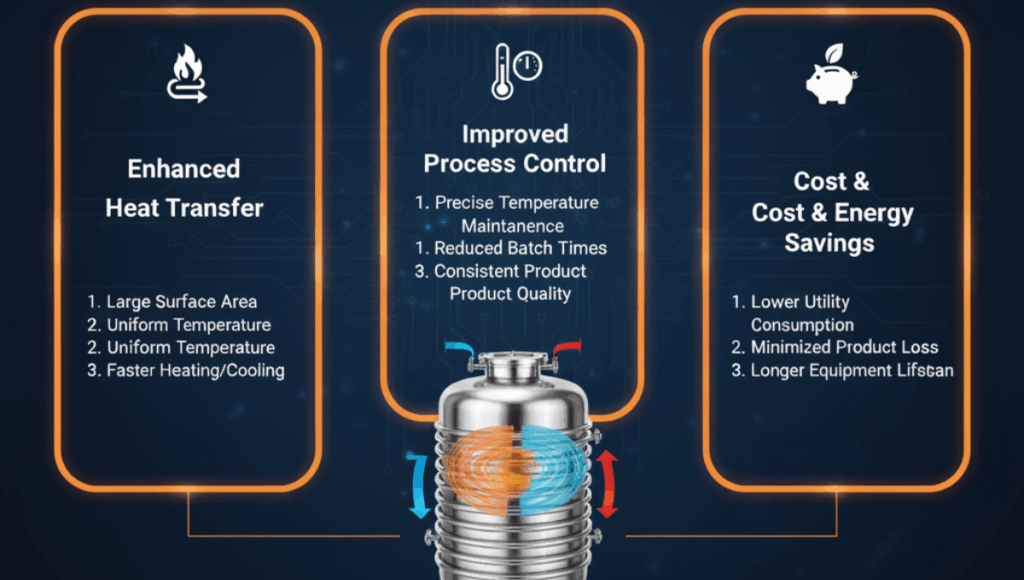
One of the biggest advantages of a limpet coil design is its ability to deliver higher heat transfer rates compared to traditional jacketed vessels. Here’s why that matters.
In a standard jacket, the heating or cooling medium flows through a wide annular space between the vessel wall and the outer jacket. This creates slower fluid velocity and lower turbulence, which reduces the heat transfer coefficient. In practical terms, it takes longer to heat up or cool down your batch.
Limpet coils solve this problem by creating a smaller, more controlled flow path. The half-pipe design forces the thermal fluid to move faster and with more turbulence, increasing contact with the vessel wall. This translates to faster temperature changes and better process control.
For exothermic reactions where heat needs to be removed quickly to prevent dangerous temperature spikes, this difference becomes critical. The improved heat transfer can reduce batch cycle times by 15-20%, allowing you to process more batches per day without compromising safety or quality.
When you’re working with high-pressure processes, vessel design matters. Limpet coil tanks offer a structural advantage that’s often overlooked.
The half-pipe coils welded to the exterior act as reinforcement ribs, adding strength to the cylindrical shell. This means the vessel can handle higher internal pressures without requiring thicker walls or additional support structures.
In practical applications, this allows facilities to run reactions at elevated pressures while using thinner, lighter vessel walls. The result is lower material costs during fabrication and easier installation. For the same wall thickness, a limpet coil vessel can typically withstand 20-30% higher pressure compared to a standard jacketed design.
This becomes particularly relevant in high-temperature applications above 150°C, where the combination of heat and pressure creates significant stress on vessel walls. The coil reinforcement helps distribute these stresses more evenly.
Energy costs add up fast in continuous manufacturing operations. Limpet coil tanks help reduce these costs in several ways.
First, the improved heat transfer means you need less time to reach target temperatures. Less heating time means less energy consumed per batch. When you’re running dozens or hundreds of batches per month, these savings compound quickly.
Second, the smaller volume of heating or cooling media in the coil (compared to a full jacket) means faster response times. Your system can switch between heating and cooling cycles more quickly, with less wasted energy during transitions.
Third, the design minimizes dead zones where thermal fluid can stagnate. In jacketed vessels, poor circulation can create cold or hot spots that reduce efficiency. The forced flow through limpet coils eliminates this problem, ensuring every square inch of coil surface is actively transferring heat.
Facilities that have switched from jacketed to limpet coil systems report energy savings of 10-15% on thermal processes, which translates to significant cost reductions over the equipment’s 15-20 year lifespan.
Pharmaceutical manufacturing demands precision. Product quality, safety, and regulatory compliance all depend on maintaining exact process conditions. Limpet coil tanks excel in these demanding environments.
During active pharmaceutical ingredient synthesis, temperature control directly affects product purity and yield. Many reactions require holding temperatures within ±2°C for extended periods. Some processes involve rapid cooling to stop reactions at precise moments.
Limpet coil reactors provide the responsiveness needed for these operations. The high heat transfer coefficient allows quick temperature adjustments, while the uniform distribution prevents localized hot spots that could degrade sensitive compounds.
For exothermic synthesis reactions, the ability to quickly remove heat prevents dangerous temperature runaways. This isn’t just about efficiency; it’s about safety and regulatory compliance.
Crystallization is a common purification method in pharma. The crystal size, shape, and purity all depend on precise cooling rates. Too fast, and you get small, poorly formed crystals. Too slow, and the process takes too long.
Limpet coil tanks allow precise control over cooling curves. Operators can program specific cooling rates and maintain them consistently across the entire batch. This level of control improves product consistency and reduces the need for reprocessing.
Good Manufacturing Practice (GMP) requirements in pharma are strict. Equipment must be easy to clean, maintain, and validate. Limpet coil designs support these requirements through several features.
The external coil placement means no internal components to trap materials or create dead spots. The smooth interior surfaces of stainless steel vessels (typically SS 316 or SS 316L) can be mirror-polished to prevent product buildup and bacterial growth.
Manufacturers like ASEFS India provide vessels with proper documentation, material certifications, and design compliance to support regulatory inspections. These details matter when auditors review your facility.
Also Read:- Applications of Rubber Lined Pipe Spools in Process Industries
Chemical manufacturers face different challenges than pharma, but temperature control remains just as critical. Whether you’re producing polymers, resins, or specialty chemicals, heat transfer efficiency directly impacts product quality and plant economics.
Polymerization reactions are notoriously heat-sensitive. Most are highly exothermic, releasing large amounts of heat that must be removed quickly to control molecular weight and prevent thermal degradation.
Limpet coil reactors are particularly well-suited for these processes. The high heat transfer area and efficient cooling allow tight control over reaction temperatures, which determines polymer properties like molecular weight distribution and chain length.
For continuous polymerization processes, the ability to maintain stable temperatures reduces batch-to-batch variation and improves product consistency.
Many chemical plants run multiple product lines through the same equipment. This requires flexibility in operating temperatures, pressures, and heating/cooling methods.
Limpet coil tanks support this flexibility through zoning. Multiple coil circuits can be installed and operated independently, allowing different zones of the vessel to be heated or cooled separately. This creates opportunities for multi-stage processes in a single vessel.
Double limpet coil designs take this further by providing separate coils for heating and cooling. One coil carries steam or hot oil, while the other circulates chilled water. This eliminates the need to purge and switch media, speeding up cycle times significantly.
Chemical processing often involves corrosive substances that attack standard materials. Limpet coil vessels can be fabricated from specialized materials to resist specific chemicals.
Stainless steel grades like SS 316L offer excellent corrosion resistance for most applications. For more aggressive environments, exotic alloys (Hastelloy, Monel) or specialized coatings can be specified.
The external coil placement also means the heating/cooling circuit can be made from different materials than the vessel interior. For example, you might have a glass-lined interior for product contact, with carbon steel or stainless steel coils on the outside. This material flexibility reduces costs without compromising chemical compatibility.
Also Read:- Lifting Brackets for Scaffolding: Types, Safety & Applications
Understanding the trade-offs between these two designs helps you make better equipment decisions.
The right choice depends on your specific process requirements, budget, and operating conditions. Many facilities use both types, selecting the design that best fits each application.
Getting the most from a limpet coil tank requires attention to design details. Here’s what matters.
The material choice affects corrosion resistance, temperature limits, and cost. Common options include:
The coil design impacts heat transfer and flow distribution. Key parameters include:
The agitator design works with the heat transfer system to ensure uniform conditions. Common options include:
The agitator must be matched to your product viscosity, batch size, and mixing requirements. Poor agitation can negate the benefits of good heat transfer design.
External insulation reduces heat loss and improves energy efficiency. For high-temperature applications, proper insulation can reduce energy costs by 20-30%.
Stainless steel cladding over the insulation provides a clean, professional appearance and protects the insulation from damage. This is particularly important in GMP environments where cleanliness and appearance matter.
Even the best-designed equipment won’t perform well without proper installation and operation. Here are key practices that maximize performance and lifespan.
During installation, ensure proper support and leveling. Thermal expansion during operation can create stress if the vessel isn’t properly mounted. Allow for thermal movement in piping connections.
Verify that utility connections (steam, cooling water, thermal fluid) are sized appropriately. Undersized piping restricts flow and reduces heat transfer efficiency.
Install proper instrumentation for monitoring. At minimum, you need temperature sensors for the vessel contents and the thermal fluid inlet/outlet. Pressure sensors help detect flow issues or blockages.
Establish clear procedures for startup, operation, and shutdown. Rapid temperature changes can create thermal stress, particularly at weld joints between the coil and vessel shell.
For heating operations, preheat gradually to avoid thermal shock. For cooling, avoid introducing very cold water directly into hot coils. Gradual transitions extend equipment life.
Monitor for leaks regularly. A small leak in the coil can contaminate your product or cause pressure loss that reduces efficiency. Early detection prevents bigger problems.
Regular inspection is essential. Check welds between coils and shell for signs of cracking or corrosion. These areas experience high stress from thermal cycling.
Clean the coils periodically to remove scale or fouling. Buildup on either side of the heat transfer surface reduces efficiency. The cleaning frequency depends on your heating/cooling media and operating conditions.
Document all maintenance activities. This creates a history that helps predict future issues and demonstrates compliance with regulatory requirements.
When selecting a manufacturer for limpet coil tanks and pressure vessels, experience and quality standards matter. ASEFS India brings over 38 years of fabrication expertise to the chemical and pharmaceutical industries.
The company specializes in custom-engineered solutions, including pressure vessels, storage tanks, and reactor systems designed to exact specifications. Every product undergoes rigorous testing and inspection before delivery, ensuring compliance with international standards.
ASEFS India’s capabilities include pressure vessel fabrication in stainless steel and carbon steel, custom limpet coil configurations for specific heat transfer requirements, and GMP-compliant designs for pharmaceutical applications. Their engineering team works directly with clients to design solutions that match process requirements and budget constraints.
For facilities looking to upgrade existing equipment or install new processing capacity, working with an experienced fabricator like ASEFS India ensures you get equipment that’s built right the first time. Proper design and fabrication directly impact long-term reliability and operating costs.
What is the main advantage of a limpet coil tank over a jacketed vessel?
Limpet coil tanks offer superior heat transfer coefficients due to higher fluid velocity and turbulence in the coils. This translates to faster heating and cooling, shorter batch cycles, and better temperature control. The coils also add structural strength, allowing the vessel to handle higher pressures with thinner walls, which reduces material costs and weight.
Can limpet coil tanks be used for both heating and cooling?
Yes, limpet coil tanks are highly versatile. Single coil designs can switch between heating and cooling media, while double coil configurations provide simultaneous heating and cooling capability. This flexibility makes them ideal for complex processes requiring rapid temperature changes, such as exothermic reactions followed by quick cooling for crystallization or product stabilization.
What industries benefit most from using limpet coil tanks?
Chemical processing, pharmaceutical manufacturing, food production, and petrochemical industries gain the most benefit. Any process requiring precise temperature control during reactions, crystallization, polymerization, or distillation can see improvements in efficiency, product quality, and energy costs. High-temperature applications above 150°C particularly benefit from the limpet coil design’s superior heat transfer capabilities.
How do limpet coil tanks comply with GMP requirements for pharmaceutical use?
Limpet coil tanks meet GMP requirements through several design features. The external coil placement eliminates internal components that could harbor contaminants. Stainless steel construction (typically SS 316 or 316L) with mirror-polished interior surfaces prevents product buildup. Proper documentation, material certifications, and design compliance with standards like ASME support regulatory inspections and validation processes required in pharmaceutical facilities.
What maintenance do limpet coil tanks require?
Regular inspection of welds between coils and vessel shell is needed to detect stress cracking from thermal cycling. Periodic cleaning removes scale or fouling that reduces heat transfer efficiency. Leak testing should be performed routinely using pneumatic methods. Proper startup and shutdown procedures (gradual temperature changes) help extend equipment life. Documentation of all maintenance activities supports regulatory compliance and helps predict future maintenance needs based on operating history.



At A.S. Engineers & Fabricators, our team excels in designing, manufacturing, and erecting steel structures that set industry benchmarks. We have established a robust presence in metal fabrication, heavy equipment, and steel structures, providing top-tier solutions for industrial plants and high-rise buildings.
+91 92267 69978
+91 89569 38780
info@asefsindia.com
2025 © A.S Engineers - All rights reserved