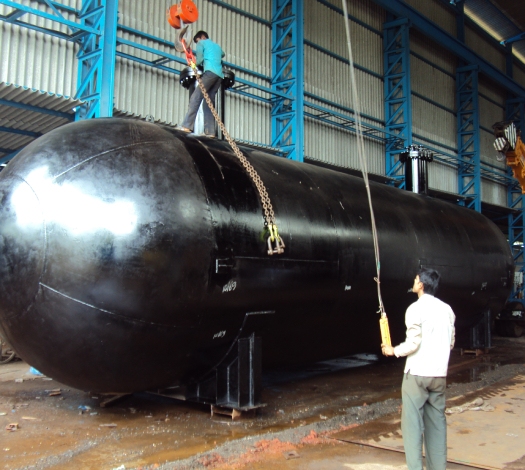
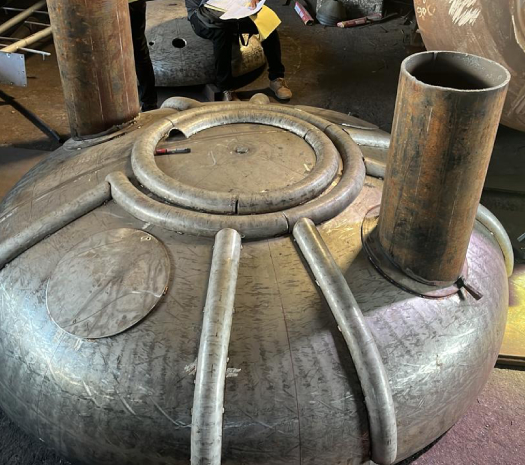
Pressure vessel ends, also known as dish heads, are essential components for closing or terminating cylindrical pressure vessels. In this article, we will explore the different types of pressure vessel ends commonly used and their design features.
Pressure vessel ends (dish heads) are important industrial equipment for companies in the oil and gas, petrochemical, power generation, food processing, chemical manufacturing, pharmaceutical, and other sectors. Asefs India is a leading supplier of dish heads for a wide range of industrial applications.
Pressure vessel ends are simply curved plates of metal used for closing or terminating pressure vessels, such as tanks, boilers, reactors, storage vessels, columns, and other equipment designed to operate at elevated pressures.
Flat plates are not used as ends, as curved heads are much more efficient at handling internal pressure and stress.
The shape of a dish head significantly affects its pressure resistance capabilities. Asefs India has extensive experience in forming dish heads with high precision to achieve the required structural performance and safety.
Also Read:- Checkered Plates Explained: Uses, Grades & Benefits in Industrial Flooring
Flat plates are primarily subjected to bending stresses, which must be within allowable limits. To ensure sufficient safety margins, a flat plate must be much thicker than a curved head of the same diameter and pressure rating. As a result, flat heads are rarely used on pressure vessels, if at all.
Curved heads efficiently convert internal pressure into membrane stress, which is more uniformly distributed and more stable from a structural point of view.
Enhanced pressure resistance
Higher safety factors
Lower material thickness
Longer lifespan
Minimal deformation risk
Asefs India supplies high-quality pressure vessel ends manufactured to the appropriate safety standards.
Below are the most common types of pressure vessel ends or dish heads used in various industrial applications.
The torispherical head is one of the most common types of vessel ends. It is also known as a flanged and dished head.
A torispherical head is made of:
A spherical crown
Knuckle radius
A straight flange
The distinctive features of a torispherical head are:
Cost-effective to manufacture
Acceptable for moderate pressure applications
Extensively used for storage vessels.
Torispherical heads are used in:
Chemical tanks
Air receivers
Water treatment vessels
Asefs India can manufacture flanged and dished heads to suit customer requirements.
The 2: 1 elliptical head depth is one-fourth of the vessel’s diameter.
The key features of a 2:1 elliptical head are:
Better stress distribution
Greater pressure capacity than a torispherical head
Efficient structure
The 2:1 elliptical head is used in:
Boilers
Heat exchangers
High-pressure reactors
Ellipsoidal heads are a popular choice when higher pressure resistance is needed. Asefs India can produce 2:1 elliptical heads with high dimensional accuracy.
The hemispherical head resembles half a sphere in shape and offers the best pressure resistance of all types of pressure vessel heads.
Its key features are:
Uniform stress distribution
Maximum strength
Suitable for high-pressure applications
The main applications of the hemispherical head are:
Gas storage vessels
Oil and gas separators
Cryogenic storage tanks
Hemispherical heads are the strongest, but more expensive than other types of heads because of the complex forming. Asefs India can provide hemispherical heads for critical pressure vessel applications.
Flat head is a simple flat plate used for very low-pressure systems only.
The main features of flat heads are:
Low fabrication costs
Simple design
Very limited pressure capacity
Flat heads are used for:
Atmospheric tanks
Smaller storage vessels
Flat heads are seldom used for pressure vessels. Asefs India supplies flat heads for applicable low-pressure applications.
A conical head is shaped like a cone and is often used in pressure vessels where smooth material discharge is needed.
The main features of a conical head are:
Smooth flow transition
Suitable for hopper system applications
Moderate pressure handling
Applications of conical heads:
Mixing tanks
Storage vessels with bottom discharge systems
Silos
Asefs India can produce conical heads for a variety of industrial systems.
Toriconical head has a conical section in addition to a knuckle radius. The additional knuckle radius helps to reduce stress concentration and improve strength characteristics.
The distinctive features of a toriconical head are:
Reduced stress concentration
Better strength compared to a plain conical head
Applications:
Chemical reactors
Fertilizer manufacturing plants
Pressure vessels for discharge applications
Asefs India can produce toriconical heads with increased reliability.
Pressure vessel ends can be manufactured from a variety of materials, including.
Carbon steel
Stainless steel
Duplex steel
Alloy steel
Aluminum
The materials for pressure vessel ends are selected based on the operating pressure and temperature, corrosion resistance requirements, and industry standards. Asefs India has a wide range of certified materials for pressure vessel heads.
Dish heads can be formed by cold pressing, hot forming, and the spinning process.
Heat treatment
Edge trimming
Non-destructive testing
Dimensional inspection
Manufacturing must meet recognized industry standards, such as ASME, DIN, and EN codes and regulations. Asefs India has a well-established quality control system in place to ensure that pressure vessel ends are made to the required standards.
Pressure vessel ends are used in many industrial sectors.
Oil and gas
Power generation
Chemical processing
Boiler systems
LPG storage tanks
Food processing
Pressure vessel ends are essential components of any system that requires containment of internal pressure. Asefs India can supply many industries with custom-made dish head solutions.
Pressure vessel ends, also known as dish heads, are essential components for securely closing cylindrical pressure vessels. Proper selection of the right type of head ensures efficient pressure containment, reliability, and long service life of the entire system. Asefs India has extensive experience and the necessary expertise to supply appropriate types of dish heads for various industrial applications.
Also Read:- What Is Galvanized Zinc? Coating Process, Benefits & Industrial Uses
Ans: The hemispherical head is the strongest and has the best pressure resistance capabilities due to uniform stress distribution.
Ans: The 2: 1 elliptical head is the most popular and widely used in many pressure vessel applications. It provides good strength and is more economical than other high-pressure heads.
Ans: Flat heads are only used for low-pressure applications and systems, where internal pressure is at or near atmospheric conditions.
Ans: Thickness is determined based on operating pressure, vessel diameter, allowable material strength, design codes, and industry standards.
Ans: The most common standards for pressure vessels and their components are ASME Section VIII and other international codes for pressure vessels and pressure equipment.

At A.S. Engineers & Fabricators, our team excels in designing, manufacturing, and erecting steel structures that set industry benchmarks. We have established a robust presence in metal fabrication, heavy equipment, and steel structures, providing top-tier solutions for industrial plants and high-rise buildings.
+91 92267 69978
+91 89569 38780
info@asefsindia.com
2025 © A.S Engineers - All rights reserved