
Choosing the right pressure vessel dish end affects everything from structural safety to material costs. Whether you’re designing boilers, storage tanks, or chemical reactors, understanding the differences between hemispherical, ellipsoidal, and torispherical dish ends helps you make smarter engineering decisions.
These end closures do more than seal cylindrical vessels. They handle stress distribution, pressure containment, and space constraints in ways that directly affect performance and budget. Getting this choice right means avoiding costly redesigns and ensuring your equipment meets safety standards.
Pressure vessel dish ends are curved metal components welded to the open ends of cylindrical vessels. Think of them as specialized caps that complete the pressure boundary while managing the forces inside.
Unlike flat closures, dished ends distribute pressure more evenly across their surface. This curved geometry reduces stress concentration points that could lead to failure. The shape matters because pressure creates tremendous forces that a flat surface simply can’t handle efficiently.
ASEFS India manufactures various dish end configurations for industries ranging from petrochemical to food processing. Each type serves specific pressure ratings and space requirements.
The three main types vary in their curves, depths, and how they manage stress. Here’s what sets them apart.
A hemispherical dish end forms a perfect half-sphere with the radius matching the vessel’s cylindrical section. This simple geometry creates the most efficient pressure containment.
The spherical shape distributes pressure equally across the entire surface. Every point on a hemisphere experiences the same stress level, which means no weak spots or concentration zones.
This even distribution lets you use thinner walls compared to other dish end types. For the same pressure rating, a hemispherical head typically needs only half the thickness of the cylindrical shell.
High-pressure applications benefit most from hemispherical designs. When your vessel operates above 1,000 psi or handles large diameters under significant pressure, this geometry provides the best strength-to-weight ratio.
Storage spheres for liquefied gases often use opposing hemispherical heads. Chemical reactors operating at extreme pressures rely on this configuration for safety margins.
The downside? Manufacturing complexity. Forming a perfect hemisphere requires specialized equipment and more fabrication time. This translates to higher upfront costs compared to shallower alternatives.
Space requirements also increase. The depth of a hemispherical head equals half its diameter, which can be a problem in facilities with height restrictions.
Also Read:- Top Dish End Manufacturers in India: Quality, Standards & Pricing Guide
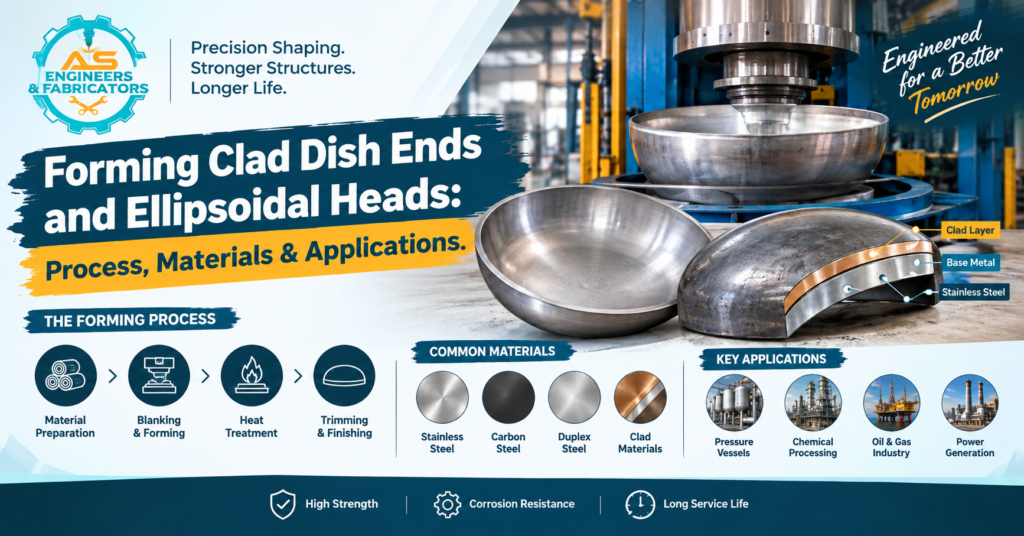
An ellipsoidal dish end, commonly called a 2:1 elliptical head, features an ellipse-shaped curve. The major axis measures twice the length of the minor axis, creating a gentler slope than a hemisphere.
This shape offers a middle ground between strength and economy. The curved surface still distributes stress relatively evenly, though not as perfectly as a hemisphere.
Wall thickness requirements for ellipsoidal dish ends come close to matching the cylindrical shell. Engineers appreciate this because it simplifies welding and reduces the need for thickness transitions.
The depth equals one-quarter of the diameter, significantly less than hemispherical heads. This saves material and reduces vessel height.
Medium to high-pressure vessels commonly use ellipsoidal dish ends. They work well in applications where pressure ranges from 150 to 3,000 psi.
ASEFS India supplies ellipsoidal dish ends for boilers, heat exchangers, and pressure reactors where space savings matter but strength cannot be compromised. The design meets ASME Section VIII standards while keeping costs reasonable.
Pharmaceutical and food processing equipment often specifies ellipsoidal heads. They provide adequate pressure resistance without the excessive depth of hemispheres or the stress concerns of torispherical types.
A torispherical dish end combines a spherical crown with a smaller knuckle radius at the edge. This creates a flatter profile than ellipsoidal heads while maintaining structural integrity for moderate pressures.
The spherical cap portion handles most of the pressure load. The knuckle radius creates the transition to the straight flange, but this junction point experiences higher stress concentration compared to other dish end types.
Because of this stress pattern, torispherical heads require thicker walls. The thickness typically runs about 1.77 times the shell thickness for equivalent pressure ratings.
The shallow depth makes torispherical heads space-efficient. When facility constraints limit overall vessel height, this profile solves layout problems.
Low to moderate pressure applications up to 150 psi benefit most from torispherical geometry. Storage tanks, atmospheric pressure vessels, and equipment with minimal pressure differentials fit this category.
Manufacturing costs run lower than other types. The simpler forming process requires less specialized equipment and shorter production time. For budget-conscious projects with modest pressure requirements, this makes torispherical heads attractive.
Industries using torispherical dish ends include water treatment, low-pressure storage systems, and certain types of heat exchangers. ASEFS India fabricates these heads when clients prioritize cost savings and space efficiency over maximum pressure capacity.
Hemispherical heads handle the highest pressures due to perfect stress distribution. Ellipsoidal heads work for medium to high pressures. Torispherical heads suit low to moderate pressure ranges.
If your application involves pressures exceeding 1,000 psi, hemispheres provide the most safety margin. Between 150 and 1,000 psi, ellipsoidal heads balance performance and economy. Below 150 psi, torispherical heads offer sufficient strength at lower cost.
Wall thickness directly affects material costs. Hemispherical heads use the least material per unit of pressure containment. However, their greater depth means more total material than torispherical alternatives.
Ellipsoidal dish ends require moderate thickness, close to shell thickness. This similarity reduces welding complexity and minimizes transition zones.
Torispherical heads need the thickest walls relative to pressure rating. Yet their shallow profile reduces overall material volume. For large diameter vessels under low pressure, this often results in the lowest material cost.
Forming hemispheres demands specialized presses and longer fabrication cycles. The complex curvature requires precise control and multiple forming steps.
Ellipsoidal heads offer moderate manufacturing difficulty. Standard pressing equipment can produce these shapes with reasonable efficiency.
Torispherical heads rank easiest to manufacture. The combination of spherical crown and knuckle radius suits conventional forming processes. Shorter lead times and simpler tooling requirements keep production costs down.
Vessel height affects facility design, transportation, and installation. Hemispherical heads add the most height, equal to half the diameter. This can create problems in buildings with clearance restrictions.
Ellipsoidal heads reduce height to one-quarter of the diameter. This compromise satisfies many installations where some depth reduction helps.
Torispherical heads minimize vessel height. Their flat profile works best when vertical space is limited or when vessels must fit within existing structures.
Start by identifying your operating pressure and temperature. Check design codes like ASME Section VIII to determine minimum wall thickness requirements for each dish end type at your conditions.
Consider the space available for installation. Measure ceiling heights, doorway clearances, and transportation constraints. If height restrictions exist, torispherical or ellipsoidal heads may be necessary even if hemispheres offer better performance.
Calculate total material costs including wall thickness, overall size, and fabrication complexity. Sometimes a thicker but shallower head costs less than a thinner but deeper alternative.
Review your production budget and timeline. Hemispherical heads take longer to manufacture. If your schedule is tight, ellipsoidal or torispherical options might better fit your project timeline.
Check regulatory requirements. Certain industries mandate specific head types or impose additional safety factors. Verify that your selection meets applicable standards before finalizing design.
Consult with experienced manufacturers. Companies like ASEFS India can review your specifications and recommend the most appropriate dish end configuration based on real-world fabrication experience.
Carbon steel remains the most common material for pressure vessel dish ends. It offers good strength at reasonable cost and suits most industrial applications.
Stainless steel grades like 304 and 316 work for corrosive environments. Food processing, pharmaceutical, and chemical applications often require stainless for contamination prevention and corrosion resistance.
Alloy steels serve high-temperature or specialized chemical service. Each material choice affects forming characteristics, welding procedures, and final performance.
The dish end material must match the cylindrical shell material or be compatible for welding. Dissimilar metal joints require special procedures and additional testing.
Material thickness depends on both the dish end type and operating conditions. ASME code calculations account for pressure, temperature, material properties, and safety factors to determine minimum acceptable thickness.
Also Read:- Applications of Rubber Lined Pipe Spools in Process Industries
ASME Section VIII Division 1 provides the primary design rules for most pressure vessels in North America. This code specifies calculation methods, acceptable materials, and fabrication requirements.
The standard defines allowable stress values, joint efficiencies, and design factors. These parameters change based on dish end geometry, leading to different thickness requirements for each type.
ASME Section VIII Division 2 offers alternative rules using design by analysis. This approach suits complex geometries or unusual loading conditions where standard calculations may be too conservative.
International standards like EN 13445 cover European pressure vessel design. While similar in principle to ASME codes, specific calculation methods and safety factors differ.
Indian Standard IS 2825 addresses unfired pressure vessels. This code references ASME principles while accommodating local manufacturing practices.
Working with certified manufacturers ensures compliance. ASEFS India follows applicable codes and maintains documentation proving that fabricated dish ends meet design specifications.
Balance performance requirements against budget constraints. The best dish end type delivers adequate pressure containment at acceptable cost without overdesigning.
Hemispherical dish ends suit high-pressure applications where strength justifies higher fabrication costs. Ellipsoidal heads work for most medium-pressure vessels offering good performance and reasonable economy. Torispherical heads fit low-pressure applications where cost and space matter more than maximum strength.
Think beyond the initial purchase price. Consider installation challenges, inspection requirements, and long-term reliability. A slightly more expensive head that’s easier to install or inspect may cost less over the equipment lifetime.
Work with qualified manufacturers who understand both the technical requirements and practical fabrication issues. ASEFS India brings expertise in producing all three dish end types to meet diverse industry needs.
Q.What is the main difference between hemispherical and ellipsoidal dish ends?
Hemispherical dish ends form a perfect half-sphere, providing superior pressure resistance with even stress distribution. Ellipsoidal heads use an elliptical curve that’s shallower and more economical to manufacture. Hemispheres work best for high-pressure applications while ellipsoidal heads balance strength and cost for medium-pressure vessels.
Q.Can I use a torispherical dish end for high-pressure applications?
Torispherical dish ends are designed for low to moderate pressures, typically under 150 psi. Their geometry creates stress concentration at the knuckle radius, requiring thicker walls for higher pressures. For applications exceeding this range, ellipsoidal or hemispherical heads provide better performance and safety margins.
Q.How does dish end selection affect overall vessel cost?
The dish end type affects material costs, fabrication time, and total vessel height. Hemispherical heads use the thinnest walls but cost more to form. Torispherical heads need thicker material but manufacture quickly. Ellipsoidal heads offer middle-ground economics. Total cost depends on your specific pressure, diameter, and quantity requirements.
Q.What standards govern pressure vessel dish end design?
ASME Section VIII provides the primary North American standards for pressure vessel design, including dish ends. This code specifies calculation methods, material requirements, and testing procedures. European designs follow EN 13445 while Indian manufacturers reference IS 2825. All these standards ensure safety through proven engineering principles.
Q.Do different industries prefer specific dish end types?
Yes. Petrochemical plants often use ellipsoidal or hemispherical heads for high-pressure reactors. Food processing and pharmaceutical facilities prefer ellipsoidal heads that balance cleanliness with strength. Water treatment and atmospheric storage typically use torispherical heads for cost efficiency. The choice depends on pressure requirements and industry-specific regulations.


I help Engineering Importers achieve Rapid Growth and make a Positive Market Impact. I help Client achieve their Business Goals
+91 92267 69978
+91 89569 38780
info@asefsindia.com
2025 © A.S Engineers - All rights reserved